
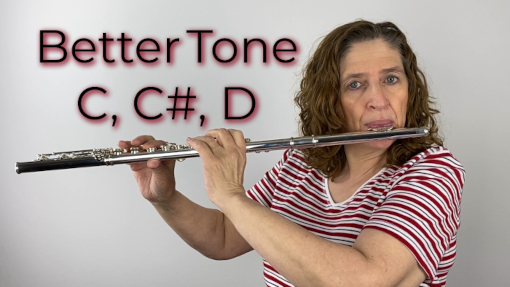
On the flute, when we play the notes C, C-sharp, D, and E-flat, we often do not produce the best tone. We can get a good tone from here up. But when we go lower to where we put that first finger up, especially D and C-sharp, those notes just don’t sound as good as they could. They just lose all center-tone focus.
This issue is something that I spent a lot of time on in college. I believed that practicing long tones would help me fix it. I did oodles and oodles of long tones. However, I did not make as much progress as I expected from all that practice.
So let me explain the keys to getting these notes.
Number one, make sure you’re covering all the holes.
You probably have an open-hole flute. Make sure that your fingers are completely covering the holes. I have seen this issue so many times with my students. Their fingers are leaking because they don’t cover the hole all the way. Then, when we work on it, they cover the holes all the way, and all of a sudden it changes everything.
However, along those lines, if your keys are leaking, it’s no fault of your own. It’s just that the mechanism itself is leaking. These leaks will show up on an E-flat or a D. If they are leaking, take your flute to a technician and have the pads checked.
So that’s something just to look at as well. The main thing is covering all the holes.
Number two, aim the air slightly differently.
Getting a better tone on your C, C-sharp, D, and E-flat may require you to aim the air across the strike edge just slightly differently.
When I play these notes and notice that there’s a little bit of lessening of the tone quality, it’s my job to mitigate that lessening of tone quality. So, I change the angle on this strike edge, and that can make all the difference. I will blow slightly down more on that E-flat than I did for the F, and that helps me.
Now I don’t even think about that anymore while I’m playing. My embouchure has been trained to know what to do. It just does it automatically on its own. You can train your embouchure too. Experiment with the angle of your air until you get a consistent tone.
Number three, lower your jaw slightly more.
Creating more space between your teeth, meaning they’re more open on the inside, can make a big difference in your tone.
By the time I reach the C, my teeth are probably about a finger’s width apart. When I hit that C-sharp and I go down, I need at least a finger’s width between my teeth. And above that, it’s definitely going to be a little bit closer. It’s not going to be as open because your airstream is different there. So, it just makes sense that you’re closing up a little bit. And so oftentimes, not only is it the airstream, but you keep your teeth closed too much, and that doesn’t help that middle area, that transition area.
We can fix the issue during lessons.
When I show students during lessons how to fix this right now, not four weeks down the road after they’ve been doing long tones, that you can get a good tone right there, right now, their eyes are open and it’s like a miracle has happened because, kind of, it has.
It’s just like, wow, I don’t have to work as hard as I’m working, trying as hard as I can, and it’s not working. No, you just need some key components, and all of a sudden that area of tone can open up to you, and now you can have consistent octaves.
Instead of starting off playing with one tone color, then changing when you get into the middle, and then getting it back later on as you go up higher, you can focus the tone all the way through. You get it right away. So, it really is sort of a mini-miracle.
So, you need to cover all the keys, focus the air, and lower your jaw. Above all else, don’t be satisfied with getting a bad tone in this area.
Alright, now you go ahead and experiment with that. Work on that middle area with your long tones and see what happens with your C, C-sharp, D and E-flat area between the first octave and the second octave and see what you can do with that. I think you’ll be happy that you’ve made these changes and now you’re getting the sound you want.
Have fun!
DoctorFlute
Watch me demonstrate this on the Brögger Flute, a beautiful Brannen Brothers handmade flute!
Get a Better Tone on Your C, C#, D, and Eb – FluteTips 187
Experimenting with Tone – FluteTips 176
Getting a Better Tone Quality on Your Middle Notes C C# D Eb – FluteTips 161

Finding Your Tone with a New Headjoint – FluteTips 158

Practice Articulation to Improve Your Tone – FluteTips 155

Tight Embouchure No Problem – FluteTips 182

How to Form a Great Flute Embouchure – FluteTips 132
