The post Play Your Scales Slowly appeared first on DoctorFlute.
]]>What I am talking about specifically is that you can learn a lot about your playing, and you could fix a lot of problems, if you take your scales at a slower clip. When you play any piece slowly you begin to hear where the problems are. Problems such as glitches and fingers that are not moving evenly. Sometimes we think we are playing evenly because we are keeping up with our metronome. But really the inside beat is uneven.
Playing Slowly Reveals Problems
Playing the scales slowly with a metronome at a slower tempo, allows me to hear exactly what is happening in the scale. We need to listen to our fingers. Just because our fingers moved really well two weeks ago, does not mean they're moving really well today. There are a lot of factors that go into our muscles, and we need to be training them all the time. I'm not just training them for one solo that I played two weeks ago. We need to be training them for every day or else we lose it.
Play a scale two octaves slowly. Listen to what is happening both in unevenness and what is happening between notes. Do you hear any glitches happening? Glitches are when your fingers all don’t go down or up at the exact same time. Even though playing the scale up and down does give you some insight into your technical issues, my shtick is that you have to interact with scales for the most benefit. Interacting with scales means playing scale exercises such as the Reichert studies or the Moyse method or Taffanel and Gaubert. Whatever method you have that has scale exercises which allow you to interact with those scales.
Interact with Scales
I will also listen to the way my tone sounds. I want to match my octaves when I play the scales. Do they all match in volume and weight and resonance, or do I get bigger as I get to the bottom and smaller as I go to the top?
Scales played slowly reveal glitches. Glitches are always hidden by speed. They are there and are the thing that makes runs not sound absolutely fluid. However, we can fool ourselves into thinking that we can play a run just fine and then we play slowly and hear that the fingers glitch. We often think that we are playing really well, but we are really hiding a glitch. Glitches can be tedious to work on. They are not the most glamorous thing to practice, but the pay off is great. Your runs will sound effortless. Maybe you are still working really hard, but to a listener, that work sounds effortless. You want that as a goal. You want the listener to think that what you are playing is effortless. Then the listener can concentrate on the music that you produce.
Make Your Embouchure Flexible
So, this is what I mean when I say you should practice scales slowly. You can play your scales up two octaves and down two octaves and then move on to the next one. But interacting with scales helps to reveal more problems and thus make you a better performer. A lot of times this is the kind of thing that separates the amateur from the professional. Sometimes it is really tedious work. But the payoff is fabulous. So, work on playing your scales slowly. You will like the results.
Have fun!
DoctorFlute
Play Your Scales Slowly - FluteTips 139
Making Your Embouchure Be Flexible While You're Playing - FluteTips 87
Marcel Moyse Scales and Arpeggios - FluteTips 95
Fixing the Glitch Exercise with Taffanel & Gaubert 10 & 11 Practice with Me
The post Play Your Scales Slowly appeared first on DoctorFlute.
]]>Have you ever studied Cécile Chaminade's Concertino in D Major Opus 107?
Learn with me as I teach through the Concertino in 6 parts, highlighting areas that might be technically and rhythmically difficult.
In this first video I will cover only the first 15 measures. This is the opening to the whole piece. It sets the tone and it's so beautiful and lovely.
Don’t Rush the Triplets
When students play this opening for me, one of the most common errors they make is in the rhythmic timing of the duplets contrasting with the triplets. The first measures begin with eighth and then immediately move to triplets and back to eighths. It's back and forth and back and forth.
Almost always if there's a problem, the triplets are played too fast, they are rushed. The best way to conquer this is to practice these measures with a metronome. Listen very carefully. Even with a metronome they can be played wrong. Don't try to be musical with it just yet. Learn the rhythm carefully first. Once you feel that you have it down then listen for the phrasing and nuance.
Don’t Start Too Softly
Another mistake that flute players make is beginning the piece too softly. If you begin too softly then most likely you are sacrificing tone. Use the mf to your advantage. If you play mf as it says then you can bring out your tone. It will help you feel like you are beginning strongly. It makes it just so lovely to start off with a beautiful not overly loud sound but just a nice comfortable mf sound.
Lets talk tenuto. Sometimes when students play these tenuto notes they misinterpret what that really means. It does not mean to change the rhythm. I like to think of tenuto notes as sticky notes. I want to think of these notes as if I can't get off them. I want to play them not too short or too long but elongated and sticky.
Sticky Tenuto
If you hold the tenuto too long, then you will change the rhythm. But, it you hold the tenuto too short, then they are not special.
That covers the opening. Now lets continue and look at the dynamics. There are a lot of them.
In m. 6 it begins with a diminuendo. That causes some consternation. Because at the end of the opening phrase in m. 5 which was your opening phrase, you've tapered and gotten softer. Now you must come in louder than when you ended so that you can dim. bigger than that.
Articulate!
Articulation is very important. I haven't discussed this yet but it is important as we have come to the time in musical history that composers began to write in their own dynamics, which up to this point were either non-existent or sparse. So, now go back to the beginning put all the articulation in, up to this point.
I bet your playing is really beginning to sound nice, isn't it?
Beginning in m.11 the opening motive is heard again, except this time it is higher. That makes it much more intense and more dramatic. Use that drama to shape these last few measures to m.15.
That's your opening through measure 15. How is it going for you? Are you feeling like the measures are taking shape? If not, do them again and work harder at expression.
Work on that opening. Explore your range of dynamics and articulation. Make sure that there's a nice tah where there's supposed to be a tah. Whatever's written here was written by the composer. So, put those in. And compare your duplets with your triplets to make sure that you're not short-changing the triplets by rushing through them.
That's your 1st 15 measures.
Have fun working on Chaminade.
DoctorFlute
Watch me demonstrate this:
Learn Chaminade 1st 15 Measures Cécile Chaminade Flute Concertino in D Major Op 107
Learn Chaminade mm 15-30 Cécile Chaminade Flute Concertino in D Major Op 107
Learn Chaminade mm 33-70 Cécile Chaminade Flute Concertino in D Major Op 107
Learn Chaminade The Vivo Cécile Chaminade Flute Concertino in D Major Op 107
Learn Chaminade The Cadenza Cécile Chaminade Flute Concertino in D Major Op 107
Learn Chaminade The Presto Cécile Chaminade Flute Concertino in D Major Op 107
The post Learn Chaminade Concertino 1st 15 Measures appeared first on DoctorFlute.
]]>The post Doll’s Waltz Köhler 25 Romantic Etudes Op 66 No 2 appeared first on DoctorFlute.
]]>Mark the Cadences
The first thing I would suggest that you do is find and mark all the cadences. Köhler is very consistent with his phrase lengths. So, if you look through or play through, you’ll see and hear that at the end of every 8 bars there is a cadence. Almost without fail. Go through the etude right now and mark all the cadence points. Make sure you don't count the first 3 notes, which are pickups into the phrase, as the first measure of the 8 bar phrase. Now, go through and play all the phrases, listening for the cadence and see if what you selected works. The next approach is to look at the phrases. Play through the first phrase. It ends with a question on the high E. It doesn't feel like an end does it? The second phrase is going to be the answer. When you play the second phrase then you feel like you played a complete phrase and it makes sense to think of it as question and answer. Play both phrases together and you feel like its a complete thought.Q & A
Let's go back and talk a little bit more about the style of the waltz. I it's very lilting. You're just moving up and down these little runs as if you had a ball maybe in a concave hill and that ball is rolling down the side and up the other. It goes a little bit faster as it goes down and it pulls back a little bit as it goes back up the other side. When I play the first phrase I ever-so-slightly pick up the tempo as I go down, then pull back as I go back up. Now if I had a metronome on, I want my measures my 1 to a measure to always be with the metronome but in the middle, beats 2 and 3 can be pushed and pulled ever-so-slightly. I also like to pull or slightly tenuto the first note after the pick-ups. Look at the notes that you are playing and see that Kohler likes groups of 2. He writes a melodic idea then says it again followed with an answer to that idea. Sometimes the 2nd time that idea changes at the end. Kohler continues on with this idea adding a concluding cadence and begins section B.Add Drama
In this section I like to get a bit more dramatic. Your articulation is just a little bit more solid and steady, not too staccato but stronger. I'm also going to think of style with more of a forte and a stronger tongue. You could also play around fortes, pianos and crescendos. Now we're going to get into a transition back into the A section. I like to keep the transition bars full and forte until the chromatic passage which moves back to the elegant waltz. In measure 58 coming down chromatically you begin forte but then, to get back into the A -Section, you should begin to pull back until you reach those same 3 pick up notes. Take a breath before them and then come back in the same as you would from the beginning continuing on until you reach the ending cadence on that nice beautiful lilting high G which of course is not a great note to play nice and soft. That's how I would practice through the Doll's Waltz from Köhler's 25 Romantic Etudes. It's a beautiful etude, and the whole set is wonderful. Practice it, listen to it, and work on it. You'll learn a lot. Have Fun! DoctorFlute Watch me demonstrate this: Practice with Me Dolls Waltz Köhler 25 Romantic Etudes Op 66 No 2 How to Practice Etudes


The post Doll’s Waltz Köhler 25 Romantic Etudes Op 66 No 2 appeared first on DoctorFlute.
]]>The post Practicing Triplet Scales appeared first on DoctorFlute.
]]>When I practice triplet scales I play through all of them. I begin with C, and travel the circle of 5ths. When you know these scales really well, you can play them at a good clip. So, it doesn’t really take too terribly long to play them all. I find them quite fun.
Triplet Scales add variety to my practice.
They are fantastic for making the fingers move.
Practicing triplet scales will help you to increase your muscle control.
These scales will be fantastic to help in sight reading as they go through every major key and every minor key including all 3 types of minors.
These scales can help tone development as you should be thinking about your embouchure changes as you traverse the octaves.
If you haven’t started with triplet scales yet now is the time to begin. Don’t try to get through all of them in the beginning as you will go quite slowly at first. My students begin with C. Then I assign 1 flat and 1 sharp each week. When they have made it through the entire circle of 5ths, I have them begin again. But this time they work for speed.
If you can play it all in one breath, then you’ve really got something to write home about!
Right now go practice these scales and watch what happens to your technique. You’ll be amazed.
Have fun!
DoctorFlute
How to Practice Triplet Scales
Practice with Me Triplet Scales C, F and G Major Scales with Their Relative Minors A, D, and E
Practice with Me Triplet Scales 2b & 2# – Bb & D with Their Relative Minors G & B
The post Practicing Triplet Scales appeared first on DoctorFlute.
]]>The post Practice with Me Low Register Tonguing appeared first on DoctorFlute.
]]>We all have trouble getting our low notes to come out with a very short tongue. If you have to triple tongue or double tongue in your low register, it often comes out as big puffs of air.
Even when you use a short single tongue there often is just an airy puff of sound.
You can work on this to improve your short low register tonguing. It takes work, is tedious and doesn’t happen quickly. But, if you work at it, it will get better and you conquer the beast.
I’m going to explain an exercise that I’ve used for a long time both for me and for my students. The exercise is just a C chromatic scale going down. I’ll explain the exercise to you and what you should look out for and how you should do it.
When you begin to practice low register tonging you have to tongue very short. If you tongue with any length at all, then you allow for the sound to start vibrating and come in. You can actually fool yourself into thinking that you actually got it.
By keeping the tongue very short you will get a dose of reality.
What really happens when we tongue our low register is that we get air and then sound.
Tongue – Air – Sound
Try tonguing a low C and see what happens. Is there a delay?
The key to working on your low register is learning how NOT to blow air.
Always, always, always, there’s too much air coming out. For some reason our instinct is to blow harder. Here are the bones to the exercise. You are going to take a C chromatic scale going down. You’re going to use C as your anchor. You’ll begin with tonguing a middle C, then B, back to C, B♭, back to C, A, back to C, A♭, back to C, G, all the way down to low C.
At first, it may appear that you can get it, C to B is not bad it’s only when you get down to E♭, and D, and low C♯ that they start getting really tricky.
Now the nitty-gritty:
- Take a good breath and gather that support.
- Don’t let the air out, tighten your stomach muscles so that you can control the air.
In other words, create support by creating pressure. - When you “ta” the note, make sure your tongue is as far forward as you can get without being on your teeth. You should be tonguing on that little nob on the roof of your mouth between you front teeth. You are NOT tonguing on your teeth. Think of your tongue as a point and use that point to tongue. If you tongue farther back you will hear that your tongue cannot be as sparkly sounding. It has a duller “ta” sound. But when I keep it on the nob and very pointed the sound is crisp and clean.
- Keep space between your teeth when you get ready to tongue the first note. Think of your embouchure being an “ah” sound with perhaps a fingers width between your teeth. This gives the sound room to vibrate and resonate as it comes out. Make sure that as you tongue your teeth stay apart. Your instinct will be to close your teeth. So, fight it!
- Now get ready to tongue the first note. Open the embouchure, take your breath and hold it for a second. Position the tongue, and then tongue a very short C.
- After the C, descend chromatically, always returning to the C after each note.
- You must tongue very short and hold your air in.
- One way to think about it is to only use the air that is in your mouth. Don’t blow any air. Hold it all in.
- When you find a note that doesn’t come out try tonguing it a few times, always using the technique above.
This exercise can be very frustrating and tedious. It is best to do this a few times a day for 10 minutes or so. Any longer and you won’t be concentrating. Play the difficult notes a few times. Then move on.
This is not a quick fix. It’s an exercise that you figure out over time. It may be a few weeks or maybe a few months.
Just keep at it.
When you feel this is beginning to work for you, then mix it up by doing the same exercise upside down. Begin with low C as your anchor, and go up chromatically, always returning to that low C.
This one is a real barrel of laughs.
You want to get your low notes to speak when tongued quickly?
Here is where you start.
Now get to it!
Have fun.
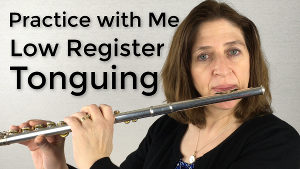
Watch me demonstrate this: Practice with Me Low Register Tonguing
FluteTips 46 Practicing Triple Tonguing in Reverse
FluteTips 19 Low Register Tonguing

FluteTips 47 Pizzicato Tonguing

The post Practice with Me Low Register Tonguing appeared first on DoctorFlute.
]]>The post How to Practice Triplet Scales appeared first on DoctorFlute.
]]>Let me teach you how to practice triplet scales. They’re very good for increasing your muscle control, for technique, and to gain control over your speed and tongue. And as a side benefit it will help increase your skill at triple-tonguing as well. Are you ready to jump in?
Triplet scales are a lot of work. You won’t merely be playing your major scales you will also be playing their relative minors and I mean all their minors – natural, harmonic, melodic. As if that is not enough, when you play each scale in triplets you must play each one 3 times to end up on the first note of the triplet. And as if that is still not enough, each scale is played slurred and triple tongued. This means when you play a triplet scale you will end up playing each scale 6x (slurred and triple tongue) and with 3 separate minor scales (natural minor, harmonic minor, melodic minor) each played 6x then a simple matter of mathematics and viola, you’ve played 24 scales.
At first this might seem daunting.
Let me tell you, it isn’t quite so scary,
when you’re actually playing them.
When I'm practicing triplet scales, I go through all major and minor scales in one session. I’ve played them for many years (almost daily) and I do them at a fast clip. But to begin, my private students will go through one major/minor combination a week. In this practice, we'll do a couple scales.
Why don’t you actually try the C major scale out. Play the C scale in triplets slurring groups of 3 or 6. It is easier in the end to slur everything. At the beginning however, it is easy to get off. So, slurring groups of 3, and accenting slightly the first of the 3, helps keep you on track.
Remember that you must play the scale 3x times up and down, in order to end on the beginning of a triplet. Begin slowly. You’ll be glad you did.
After that, triple tongue the scale.
I believe that using TKT KTK is the best. But, there are other ways to do it. If your teacher wants you to use something different, go ahead. It won’t ruin the scale! If you aren’t comfortable in the triple tongue realm, go slowly and slightly accent the beginning of each triplet. Go up and down 3x and end on the beginning of a triplet.
At first, all may not go smoothly. The problem generally is breathing. If you breathe randomly any place you want, then the triplets will get off. You must train yourself to breath only in between triplets, not in the middle of the triplet.
Keep trying!
These scales will get easier and more fun.
When you have finished with the C major scale, then move to the A minor scale. Play all the derivations of the A minor scale. Do them all slurring and triple tonguing.
Are you still with me?
It really isn’t too much if you take one major/minor combination at a time. I like my students to get through all the keys at a slow tempo. After they are reasonably comfortable with a moderate tempo in all the keys, then we start back at the beginning to work on speed.
In the end, your ultimate goal is to play up and down the 3 scales (for one key) in one breath. The tempo may vary for each person but the result is amazing technique and muscle control.
Have fun with triplet scales!
Doctor Flute
Watch me demonstrate in these two videos:
How to Practice Triplet Scales
Practice with Me Triplet Scales
Marcel Moyse Scales and Arpeggios - FluteTips 95
The post How to Practice Triplet Scales appeared first on DoctorFlute.
]]>