The post The Dreaded Piccolo Buzz appeared first on DoctorFlute.
]]>Nip it in the Buzz
So, the thing to do is not to let that happen. How do you do that? What you need to do is build your piccolo chops – SLOWLY! What you have to do is play very easy, middle-of-the-road things, and just gradually, gradually move yourself into that higher octave.
Now, most of the time the buzz comes because you’re pinching too tightly in your embouchure. They’re too tight so that when you’re blowing that fast air, your lips are vibrating together.
Open Embouchure
So, when you work up to that high register, then the idea behind that is that you’ve learned to really support it one note at a time. Keep that embouchure open. Don’t let it close up because it can be much more open both on the flute and the piccolo than you think.
Open it as much as you can, raise your upper lip, keep the space, and really use a lot diaphragmatic pressure from your support system. Use a lot of support to get up there, and then you can prevent that buzz from happening.
Support
But, if you do start buzzing, then I would say stop immediately. Go back and play those easy etudes, and just get yourself to feel comfortable again. You’re relaxing your embouchure and not letting it get too tight.
Try that if you’re having a problem with that dreaded buzz.
Have Fun!
DoctorFlute
Watch me demonstrate this: Piccolo The Dreaded Buzz – FluteTips 25


Sattoh for Piccolo and Percussion by Katsutoshi Nagasawa


Can I Just Start with Piccolo?

FluteTips 18 Embouchure Placement


The post The Dreaded Piccolo Buzz appeared first on DoctorFlute.
]]>When we choose to play piccolo it's often because we enjoy the high tessitura. Let's face it, we all like playing that 3rd octave. It's pretty cool. But those high notes come with a price tag. That price tag is learning to get those notes without tightening the embouchure.
Now one of the biggest problems with playing up there in that 3rd octave is getting a buzz in your lips. When you're playing up in the third octave on the piccolo and your lips buzz, it's always because of these two reasons: your lips are too close together and you're embouchure is too tight.
If you are beginning your journey into the piccolo world, the worst thing to do is to jump into the upper register with wild abandon. It is a surefire road to a tight embouchure and that dreaded buzz. The key to prevent that outcome is to work up slowly. Start with etudes that don't go too high. This will help build the embouchure muscles up. Add higher notes slowly. Work your way up by adding one note, then one more note, and so on. Pick etudes that are lower. Then progress as your upper register notes increase.
Another technique to help you get your 3rd 8va notes without pinching your embouchure so tightly that your lips buzz is to use a lot of support. You must have a lot of support to play in that 3rd 8va. That means tightening your stomach muscles, pressing out on that ribcage, and pushing up with that air pressure when you play those high notes. In this way you allow this embouchure to stay nice and loose and as open as you can be to still get those notes to come out. Keep in mind that if I'm as loose as I'm going to be in the low register, of course I'm not going to get anything. So, there's some firming that must happen. Firm is a good word to use. Don't think about tightening because you will do the wrong thing. Think about getting firm. A little bit firm, not tighten it up. Because tightening is negative. Firming means support. You're supporting it up there.
As you are approaching your high notes and playing, whether you're playing orchestra music, or band music, or you're just playing for fun, you're thinking about your high notes being pushed up there by your support by your air pressure, not because you're tightening up your embouchure. Loosen up your embouchure.
I've rarely come across a student that's come to me, who isn't too tight up there in that 3rd 8va. I would say, err on the side of being too loose. Then if you can't get anything out, then firm it up a little bit. But you want to be quite loose and quite open in that 3rd 8va.
Then the other thing is just making sure your lip plate is in the right spot. How do you know it's the right spot? Experiment. If you feel like you are still loose and you're pushing from your air pressure, with your support, and you feel like there's still something not quite right up there, well then experiment with the angle on this lip plate. If I'm cracking and trying to get these notes and they crack too much, I'm going to lower my air stream too, and blow that air down a little bit. Of course, this is going to help with my intonation as well.
Start working on your 3rd 8va notes on the piccolo. it's all about air support, keep your pressure high, loosen your embouchure, have space between your lips, and angle of your air stream.
Have fun working on your 3rd octave high notes on the piccolo!
DoctorFlute
Watch me demonstrate this: FluteTips 70 Piccolo 3rd Octave Notes
Failure to Plan for Your 3rd 8va Notes is a Plan to Fail – FluteTips 181

The Basics of Starting the Piccolo
Can I Just Start with Piccolo?
Sattoh for Piccolo and Percussion by Katsutoshi Nagasawa
The post Piccolo 3rd Octave Notes appeared first on DoctorFlute.
]]>The post Piccolo Tuning appeared first on DoctorFlute.
]]>Do you know that when approaching a note from below it could be flat and the same exact note is sharp when approached from above? Crazy man!
If You Have a Piccolo You Have Tuning Issues
Professional piccolo players change their fingering depending on whether the note is approached from below or above. An avid piccolo player will learn those fingerings and how and when to use them. But sometimes you just need to pay the piper and work with a tuner. You need to learn where your piccolo is in tune. You need to learn where your low A is in tune and how the pitch changes as you move to the middle A and high A. I don't think that tuning each note with a tuner is the best use of your time.
You Need to Learn Where Your Piccolo is in Tune
One of my teachers (who was a student of Walfred Kujala) said that a great technique for learning the intonation on the piccolo is to tune arpeggios. This technique for tuning arpeggios is perfect! It places each note of the arpeggios in context with the notes above and below so you get a true picture of where that note stands from it's approach above or below.
At first, when I begin to work with my tuner and arpeggios, I will tune every single note of that chord. Much later when I am gain some confidence, I will look at the tuner less. I will just tune specific notes such as, only tuning the octaves, or the 5th of the scale. You'll notice over time that you ear begins to develop. I began to hear where I was flat or sharp within a solo much more then before. You will find out yourself how much your ear develops when working with a tuner.
You'll Notice That Your Ear will Develop
Don't be afraid of that piccolo intonation. Just pull out your tuner and get to work!
Have fun getting your piccolo in tune!
DoctorFlute
Watch me demonstrate this: FluteTips 67 Piccolo Tuning

The Basics of Starting the Piccolo
Can I Just Start with Piccolo?
Sattoh for Piccolo and Percussion by Katsutoshi Nagasawa
The post Piccolo Tuning appeared first on DoctorFlute.
]]>The post The Basics of Starting the Piccolo appeared first on DoctorFlute.
]]>If you haven't gotten one yet but plan on purchasing stop reading and go get one!
Now you've got your piccolo and its time to put it together. There is no special way to put the piccolo together. Just put it together the normal flute way. When I put my head joint on I pull it out a 1/4 inch because I've worked with a tuner and that is generally where my A is in tune. All my notes won't be in tune but It gives me a good rounded intonation.
Once the piccolo is together you can put it up to the lip and I'm sure, that if you've already played the flute, you can make some sounds right away. Or at least you should be able to! You will want to modify your embouchure. If you feel the lip plate in the same spot as you do for the flute then you will need to move the piccolo lip plate up higher on your lip. I find where the flute rests on my lip, then go up from there. If you feel when you start playing that the tone is cracking then you probably need to angle that air just a little bit lower, and move it maybe up a hair on your lip, or down a hair. Experiment with the placement and you will find your best spot.
Another mistake people make when they first start piccolo is to make their embouchure very small and tight. You can keep your embouchure much looser and much more open than you think when you play piccolo. You use your air pressure to get notes on the piccolo, not from pinching. A good place to begin is to see how loose your embouchure can be and still get a tone.
Remember at the beginning of piccolo playing you experiment. Experiment where it's best on your lip. Experiment how loose your embouchure can be. Pull out your etude book that you've been working on, and play a couple of notes on the piccolo on that etude and see where your air should be so that you don't squeak.
The best way to build your piccolo chops is to play easy etudes.
Be cautious when you want to play up in the 3rd octave. Going too high too soon is a recipe for disaster. When you begin the piccolo, you need to start with low and that means nothing above that second octave. You've got to build this embouchure up so it can handle going higher. The Köhler etudes opus 66 are wonderful etudes to begin with when you're just learning the piccolo. Yes, there are a couple of notes in the Köhler etudes that go above the second octave but not too many. Most of them stay below. Keep your embouchure growing and building in small increments.
In the beginning spend 10 to 15 minutes a day playing piccolo. Don't spend long, long periods of time. Go back to your flute. Practice. Play the flute. Learn whatever exercises you're learning and then take 10 or 15 minutes and play the piccolo. I would go through arpeggios. Use your tuner. Play arpeggios with this and etudes and that would be it right at the beginning. Start building the muscles and don't tax the embouchure too much.
The Dreaded BUZZ
When you go too high too soon what happens is that the lip gets too tight and you start getting a buzz and once you get a buzz between your lips when you're trying to reach these high octave notes it's very hard to get rid of that buzz. Go slowly.
Get your piccolo. Learn how to play it by playing low etudes. Move it up on your lip. 10 to 15 minutes a day for a while. You'll know when you start reaching those 3rd octave notes that you're playing in your etudes and a 3rd octave note pops up here and there and you realize it's easy. Then you know that you can probably start adding more higher octave notes to your playing and you can start stretching it to 20 minutes to even 30 minutes a day.
And that's how you begin on the piccolo.
Enjoy playing your piccolo!
DoctorFlute
Watch me demonstrate this: Starting Piccolo - Basics FluteTips 65

Sattoh for Piccolo and Percussion by Katsutoshi Nagasawa

Can I Just Start with Piccolo?
The post The Basics of Starting the Piccolo appeared first on DoctorFlute.
]]>The post Can I Just Start with Piccolo? appeared first on DoctorFlute.
]]>The easy answer is sure, you could just play the piccolo. You could pick it up and learn to form the embouchure and learn everything on the piccolo. However the bottom line is that it's better to start with the flute.
Should You Start with Piccolo?
You’ll learn to develop your embouchure muscles. You'll learn to get a good sound on the flute, and all the counting and stuff without having to worry about the high notes on the piccolo and how they could bother your ears over extended periods of time in practice.
When I’m learning a new piccolo piece that's really technical or really high, I will learn it on the flute first. Then I will transfer that over to the piccolo. So, I'm not spending all my time learning or playing really high on the piccolo.
Learn Piccolo Pieces on Flute First
Plus, you should use ear protection when you practice the piccolo to protect your ears. So, there's a lot of reasons why it would be better to develop this embouchure develop your flute playing skills first, and then transfer them over to the piccolo.
If piccolo is your thing, you can just play it. It's basically the same as the flute with a few adjustments. Your embouchure has to be a little bit smaller. But the fingerings are the same. It's in the same key. So, you can play the same music. A lot of what goes on the flute transfers easily over to the piccolo.
Starting on Flute Will Help on Piccolo
But should you just start on the piccolo? No, you probably shouldn't. You should start with your flute. Could you pick a piccolo and just play it? Yes, you could. But you would do more for your piccolo playing if you played the flute first. So, if you'd like to play the piccolo pick up the flute and learn your skills on something that's a little bit easier to develop that embouchure, develop your notes, develop your skills at reading music, and then move into the piccolo after that.
Have fun playing the piccolo!
DoctorFlute
Watch me demonstrate this: FluteTips 63 Can I Just Start with Piccolo

FluteTips 24 Piccolo Embouchure Placement

The Basics of Starting the Piccolo
Sattoh for Piccolo and Percussion by Katsutoshi Nagasawa
The post Can I Just Start with Piccolo? appeared first on DoctorFlute.
]]>The post How to Get in Piccolo Shape appeared first on DoctorFlute.
]]>I Don’t Have Time for Piccolo!
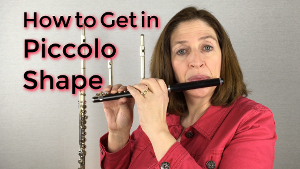
The popular idea out there right now is 30 minutes a day is all you need to get in piccolo shape. This could be true for you depending on how you use that 30 minutes. It's all in how you use your time.
If you haven't really practiced piccolo then don't jump into Tchaikovsky's 4th Symphony or the other excerpts. Just play easy material that does not take the piccolo too high or too low. You need to build the muscles for the embouchure. If you go to high to soon you risk tightening the embouchure too much and creating that dreaded buzz that happens when the lips are too close together.
Is 30 Minutes a Day All You Need?
When I am trying to get in shape or maintain shape on piccolo and I don't have time for it, this is what I do. I play through the entire book of Köhler 25 Romantic Etudes Op. 66, or the Druet Etudes. Sometimes I'll use Anderson Op. 21. Practicing these etudes for 30 minutes a day will truly strengthen your embouchure muscles, and steadily get you in piccolo shape.
Now if I am preparing for a recital with hefty literature, then I'll use the etudes as a warm-up before I get into the practice of the piece. They are a great source for warm-ups. As always, remember that your piccolo lip plate is higher on your lip then the flute. You will get a better tone if you do.
Keep Your Embouchure Up
If you don't have the Köhler Op. 66 etudes you can download them for free here:
https://www.doctorflute.com/downloads
Have fun using etudes to get back into piccolo shape!
DoctorFlute
Watch me demonstrate this: How to Get in Piccolo Shape FluteTips 61
Can I Just Start with Piccolo?

FluteTips 24 Piccolo Embouchure Placement
The post How to Get in Piccolo Shape appeared first on DoctorFlute.
]]>The post Piccolo Embouchure Placement appeared first on DoctorFlute.
]]>So, you just pick up the piccolo (the barely functional high school piccolo) and begin to play. And you know what?
You discover that you can play the piccolo!
But if you just pick up the piccolo in high school or college without any instruction from a piccolo teacher, then you’re probably making the one mistake that everyone makes.
The mistake is embouchure placement.
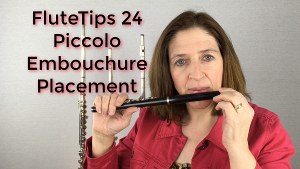
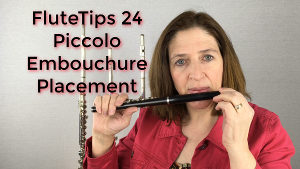
With the C flute, you play with a much larger embouchure hole. The lip can cover (generally) two thirds of the hole. So, when we put the piccolo up, we want it to feel the same way. You put it up to your lip and think “Yep, that’s where it is, and so I’m going to play it right there.”
But that’s a mistake. The embouchure hole on the piccolo is so much smaller, that your lip will cover way too much of that embouchure hole.
Experiment with moving it up on your lip.
Move it up so that it might even feel weird and awkward. At first it will feel this way because you’re used to where your flute feels. After a bit of experimenting you will hear and feel how much better the sound comes out without the tightness that is produced with too much coverage.
Move it up and see if that expands your tone and just allows freedom for that piccolo sound to come out.
Try it, you’ll like it!
DoctorFlute
Watch me demonstrate this: FluteTips 24 Piccolo Embouchure Placement
Similar Topics:
FluteTips 7 Intonation Hole Coverage
FluteTips 36 Embouchure Flexibility
The post Piccolo Embouchure Placement appeared first on DoctorFlute.
]]>