The post Bending Pitch to Work on Intonation appeared first on DoctorFlute.
]]>So, let’s talk about some tricks that you can use to really work on how to get in tune. Now, the first thing that we have is pulling your head joint in and out. So, when they play the tuning notes and you match that tuning note, you’re going to match it with your head joint going up or down.
I have my younger kids think that the way they get in tune, once they do that, then they’re in tune forever. That that’s it, that that’s the bottom line. I’ve got it out. I’m in tune with the tuner on a or with the trombones or whatever. And so that’s it. I don’t have to do anything else.
But we all know of the more mature flutists, that we must work on intonation on every note all the time because every note can be different. Every note is different with the different instruments we play with. If I play with an oboe right now, I have a group of an oboe and a bassoon, and their intonation issues are different from my intonation issues. And so, I have to be adjusting and thinking and listening all the time. But if you’ve got this in the right spot, then how do you fix intonation while you’re playing?
Well, one of the ways to do it is to bend the pitch. And by bending the pitch, you bring the pitch up or you bring the pitch down. So, it’s worthwhile to work on bending your pitch and how big of a bend can you get in your pitch? And then when you need it, you have that tool ready.
So, when we’re talking bending pitch, we’re not really saying roll in because I’ve seen that in bands in my elementary students with their band directors. So, they’ll say, Okay, just roll in. Sometimes they’re just desperate to get their bands to play in tune, and I don’t fault them for that. Just tell your flutist to, to put their head down or roll it in right, either or roll it because it will do what they need it to do. But that’s not really how we want to change our pitch. We want to practice it by having our airstream move right without our head. Because if our head moves, we’re really changing our tone and it doesn’t become a good tone, we still want to keep that good sound. So, if I practice bending the pitch, let me practice with my embouchure, I’m going to use my embouchure to do that.
Now I bent it, was there a little movement of my head? I’m sure there is a movement of my head and my eyebrows definitely have to go up that just part of it. You have to have your eyebrows go up and down when you play. If I move by embouchure sure I can really bring the pitch down a lot. It’s a little bit harder. You don’t get quite as much forward momentum by going up, but it still does go up and it can go up a little higher. Now, if I really need to go up even higher than that, I want to really lift my embouchure up out of that hole as much as I can to get in tune with whoever I have to get in tune with. Sometimes we have that problem in our highest octave is that’s, you know, our third octaves can either be really sharp or really flat, and we need to remove our embouchure in order to do that. So, practice bending. The more you practice it, the better you’ll get at it and the better you’ll get it. Keeping the tone really nice. It’s really hard not to do it without your eyebrows going up too.
I’m just moving my jaw back and forth. I’m moving that airstream. I want the airstream to move not my head. If I need to. I might do a little movement, but not a lot. I certainly don’t want to, when I move my head all the way down, I cover more embouchure hole and I’m not trying to do that. All I want to do is move my airstream and see how it’s cut on this outer edge. That’s what’s going to give me better intonation on the spur of the moment. Now, yes, you’re going to move your head joint in and out because that’s what’s necessary at the beginning to get in tune your major intonation issue and then all the minor ones that come along. You’re going to do it by bending your pitch. So then if I play just a G and I realize I’m a little bit sharp with now the oboe next to me, I’ve just lowered it. Now I’m in tune, but I haven’t changed my tone. It’s just a little bit of a difference. So, I still have the good tone that I had where, whereas if I move my head or a roll in, the whole tone sounds flat. It is not only that you’re lowering it, but also just there’s a muffled sound, in that the nice bright sound that you had goes away.
So that is what I would recommend you do to work on intonation within your ensemble, to work on every note, not to move the head a lot. We’re not going to be bobbing up and down, but to move your jaw, move your embouchure, your upper lip now going over your bottom or backing up a little bit as you even the lips out to bring in the airstream up a little higher. It’s all about manipulating that airstream.
So, practice bending pitch and you’ll really revolutionize your intonation issues and you’ll not have as many if you can do that.
Have fun!
DoctorFlute
Watch me demonstrate this idea:
Bending Pitch to Work on Intonation – FluteTips 167
FluteTips 86 Bending Your Pitch UP
FluteTips 62 Bending Pitch Extended Flute Technique
Autumn in Homeland for Solo Flute by Anže Rozman – Angela McBrearty Flute

The post Bending Pitch to Work on Intonation appeared first on DoctorFlute.
]]>The post Singing While Playing for Better Resonance in Your Tone appeared first on DoctorFlute.
]]>Singing and playing is not a very difficult thing to do it just isn't the most natural thing to do. We can all sing (yes all!) but sometimes thinking about doing that while you play seems difficult. But it isn't difficult. You can do it!
When you begin to work on this technique you should pick a piece of music or exercise that you will use when you warm-up. You can also use Robert Dick's Tone Development Through Interpretation. This book is where the singing and playing technique for tone came to fruition. Robert Dick's book is fantastic and full of new ways to develop your tone with singing and playing as only one aspect.
However, if you don't have this book, you can choose another exercise that will work for singing and playing. Pick exercises that don't skip all over the place. For example, Ex 1 in Taffanel and Gaubert's 17 Grand Exercise for the Flute. Also,if you can't sing it easily without the flute, then you won't be able to do it with the flute.
To learn how to sing and play begin by singing. Take a note located in an easy part of your singing voice and sing it gently. Then while you are singing it make an embouchure. What you are doing is showing that you can sing with a flute embouchure. Now add blowing air through your embouchure while you sing. This is going to be exactly how you will do it on the flute. If you can accomplish this then you can definitely do it on the flute.
Don't be discouraged when you try this that you might blow more air then when normally playing flute. This exercise will help you to figure out how it is done on the flute. And once you do it without the flute, you're ready to do it on the flute.
Begin by playing an F on the flute. Now take the flute away and sing the F. Put the flute back on your lip and sing. If you can't get the sound out, it might be because you need more air pressure behind the sound. Another trick to get yourself to ease up and sing is to make an embouchure away from the flute and sing an F. Then while you are singing you bring the flute up to your lip and just continue singing while the note sounds. A few time trying this and you will have it down.
How Does it Help Your Tone?
Now let's talk about why you would want to do this. There are 20th and 21st century pieces that call for this technique in the music. Singing while playing does create a very interesting effect, and adds a great nuance to a piece when that is put in by the composer. But apart from that, what does it do for you? Why would you sing and play? And what does that have to do with tone?
Part of achieving a fantastic tone is opening the throat. I would say that nearly no one who comes to me for lessons, naturally has an open throat. These students might not have a totally closed throat but it isn't totally open either. When a person sings their throat naturally opens up. It is part of the singing experience. Basically, the back of your tongue goes down, and your soft palate goes up. This creates a straight pipe that goes from you voice box all the way up into your sinuses. When you sing and play, it helps to achieve that same feeling. You can really feel the throat being open, and it helps to understand what to do when you are playing and not singing.
Try singing and playing again. Analyze what is happening. Think about that straight pipe extending from the voice box all the way to the sinuses. Ask yourself if your are keeping the throat and embouchure tension free. When you are demonstrating this remember that it doesn't have to be played fast or slow. Whatever tempo allows you to do it comfortably is great.
When you are playing the exercise with the singing, don't worry about which octave you are singing in. You want to sing in the octave that best suits your voice. When the playing gets too high, then have your voice jump down the octave. Don't ever strain to sing in and octave that is uncomfortable for you.
Now when you feel comfortable singing and playing an exercise, then begin again and somewhere in the exercise stop the singing and only play. Ask yourself if you kept the throat exactly the same. Did it close once you stopped singing? You can begin singing and playing again and stopping occasionally. Once you begin to understand and feel what it is like to play with an open throat, then you can see if you can play an exercise without singing but always analyzing what is happening with your throat.
So add singing and playing to your repertoire of warm-ups. The resonance that comes from it will be something you will want to foster. It adds this resonance because once you start engaging the sinuses, a resonance comes that you can't get any other way. You need to have that resonance for your sound to carry, for your pianos to be heard in a hall.
It's a fantastic way to practice. It's a great exercise and it gives you a little variety in your practice routine.
Try singing and playing for a more resonant tone. You'll be so glad you did.
Have Fun!
DoctorFlute
Watch me demonstrate this: FluteTips 101 Singing While Playing for Better Resonance in Your Tone
Singing and Playing to Create a Better More Resonant Tone - FluteTips 130
FluteTips 11 Support – Ribcage Air

FluteTips 26 Open Sinuses for a Better Tone


The post Singing While Playing for Better Resonance in Your Tone appeared first on DoctorFlute.
]]>The post Bending Your Pitch UP appeared first on DoctorFlute.
]]>
Pitch bends aren't necessarily difficult to execute although bending up is trickier then bending down. It's pretty easy to bend the pitch down because we can use the roll forward with our embouchure and bring the air down into the flute. It can create quite a dramatic sound.
It's a lot trickier to make the pitch go up. The same principal applies except in the opposite direction. You want to bring the air up and out of the flute. Generally, what happens is that when we need to bend up, we leave the embouchure right where it is. The result is that there is nowhere to go. If your embouchure is in the normal spot then when you try to move the air up there is only a tiny amount of distance to go before you don't have any sound at all.
The key to bending the pitch up is to start low. You need to start with the air down in the flute even at the expense of sounding flat. Now you have somewhere to go. The pitch will go up nicely because the air is so low.
In a piece such as American Suite by Bruce Stark. His second movement is the bird in the Canyon and he has a nice bunch of pitch bends both going up and down. It's a really nice piece to work on. All the movements are fantastic.
In looking at this movement, you see that he has up and down bends. When I approach the up bend I will set my embouchure to blow the note low and then bring it up as in the example in the video.
There are pitch bends going both directions in many pieces. Another piece I'm working on is Autumn in Homeland, by Anže Rozman and it's a great piece for flute alone with some really cool pitch bends.
The next time you're playing a piece by a contemporary composer that has some pitch bends going up remember start low to go high!
Have fun!
DoctorFlute
Watch me demonstrate this:
Bending Your Pitch UP FluteTips 86
Bending Pitch to Work on Intonation - FluteTips 167
FluteTips 62 Bending Pitch Extended Flute Technique
Autumn in Homeland for Solo Flute by Anže Rozman - Angela McBrearty Flute
The post Bending Your Pitch UP appeared first on DoctorFlute.
]]>There are a lot of pieces being composed today that use the extended technique of bending your pitch. Sometimes it's bending down and other times you bend up. It’s very easy to bend down it's more difficult to bend it up. Here’s some keys to think about when you're bending.
Don’t Do This in Orchestra!
Let me caveat this little instruction with warning that you’d better not try this in your lessons, in band, or in orchestra! When I work with students on intonation, I want them to learn how to change their intonation with their embouchure and by raising and lowering their air stream.
Don’t Do This in Band!
Also when playing in band or orchestra don't change your intonation by moving the head up or down or by rolling in or out. Yes, you can make a note flat or sharp with either of these techniques. But if your goal is to become a better, more accomplished flutist who is in control of the intonation of the notes you play, then you must learn the subtleties of producing notes at the right pitch by manipulating the shape of your embouchure and the direction of your air stream.
Throw the Rules Out the Window!
That said, when we perform extended techniques, we can throw all those rules right out the window. If you want to bend your pitch it’s much easier to move your head or roll your flute. We’re not trying to subtly adjust a note to get it on pitch. We’re trying to elongate a sound to achieve an effect. So, when you want to bend the pitch down – easy – bend your head and roll your flute. You have a lot of room to elongate that bending sound. However, when you want to bend the pitch in an upward direction and you start in your usual embouchure position, there’s very little space to go up.
Anticipate Bending UP
If you know that in an approaching measure, you will have an upward pitch bend then what you have to do is start lower with that pitch lower. Meaning begin the note with the embouchure tilted down and/or just plain roll in. Then you can both roll out and move your head up. It's anticipating what's coming that will help you bend up. It's all about how much you raise that air stream to bring the pitch clearly up. Starting in your normal position you won't have far to go so begin with a lowered embouchure! Have fun working on your extended techniques! All of them are a lot of fun and once you begin to learn some extended techniques, you'll be able excited to tackle any piece with extended techniques.
Have Fun!
DoctorFlute
Watch me demonstrate this:
FluteTips 62 Bending Pitch Extended Flute Technique
Bending Your Pitch UP FluteTips 86

Bending Pitch to Work on Intonation – FluteTips 167

Autumn in Homeland for Solo Flute by Anže Rozman – Angela McBrearty Flute

FluteTips 47 Pizzicato Tonguing

The post Bending Pitch Extended Flute Technique appeared first on DoctorFlute.
]]>The post Tongue Ram Extended Flute Technique appeared first on DoctorFlute.
]]>Most of the mistakes in learning how to do a tongue ram is that you blow too much air. You have to really just not blow air at all. Then, you cover up the hole, the entire way and you just barely blow and stick your tongue into the hole and it stops the sound. So, I’m going to cover up. I’m going to finger a C#. I’m not just going…
I could do it but it’s a little bit harder to just cover and put your whole mouth on it. So, if I’m playing like this, these tongue rams occur pretty quick and I can’t change my embouchure too much. So, I’m just going to go down and cover, blow a little bit and then stick my tongue into that hole.
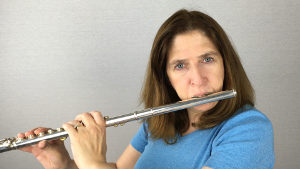
So it’s really stopping. And make sure you just you’re not actually I don’t know sticking the tip of your tongue down in there that’s not going to cover. You need to make sure that when you’re ready to ram, that you’re covering the entire hole. Like that sound would be, that’s what you’re doing with your tongue to make sure that that sound just stops immediately. So, I’ll demonstrate that again. I’m just covering the hole, breathing
and then I stick it in now also when I stop that with my tongue I’m giving a little bit of a stomach thrust in there and that helps me to really give it a good anchor stop buuh daah and it ends immediately. So, tongue rams are really fun things. There not that scary. Practice them. You can figure out how to do them.
Have fun!
Doctor Flute
Watch me demonstrate this:
FluteTips 50 Tongue Ram Extended Flute Technique

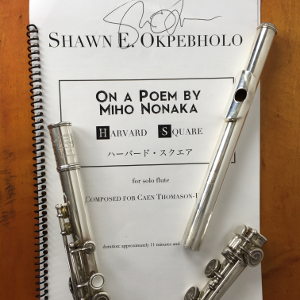
On a Poem by Miho Nonaka Harvard Square for solo flute Composed by Shawn E Okpebholo

The post Tongue Ram Extended Flute Technique appeared first on DoctorFlute.
]]>The post Pizzicato Tonguing Simplified appeared first on DoctorFlute.
]]>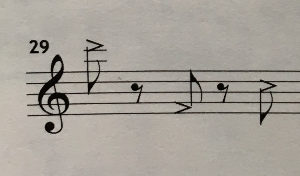 It’s indicated in music like what you see on the left. This is from a piece of music I just performed at the NFA convention a couple weeks ago called On a Poem, Harvard Square composed by Shawn E. Okpebholo. Now you do need to look at the key in pieces with extended techniques so that you are sure of what the composer wants. While there is some consensus on how to indicate these techniques sometimes a composer doesn’t comply.
The simple explanation is that all you need to do is just tongue between the lips and blow a little air at the same time. When you play these types of tonguing you are not trying to get the pitch indicated by the symbol even though they are located on a certain line or space on the staff. But, when done correctly the air sounds have a pitch to them.
To begin these I build up a lot of pressure in my stomach, or more properly, I build up the support. If I don’t keep this pressure constant the tonguing will sound floppy without the nice punctuation.
However, if I hold in the air, breathe properly, create support then when I my tongue releases the air I can get a much broader sound.
 I can double-tongue in this pizzicato style as well since the music required it.
So, to do your pizzicato tonguing, tongue between your lips, use a lot of pressure, and get that sound to echo through the flute. Make sure that your air goes through the flute but not so much that your embouchure creates a pitch.
Experiment with this type of tonguing. Don’t be afraid of it if you see it in music. It’s not that scary. It’s really quite fun to work on.
Have fun!
Doctor Flute
Watch me demonstrate this: FluteTips 47 Pizzicato Tonguing
Practice with Me Low Register Tonguing
FluteTips 46 Practicing Triple Tonguing in Reverse

FluteTips 19 Low Register Tonguing

The post Pizzicato Tonguing Simplified appeared first on DoctorFlute.
]]>The post Practice Harmonics to Improve Your Tone appeared first on DoctorFlute.
]]>What are Harmonics?
If you haven’t practiced harmonics before here is what they are: if you play a low C, and then, without changing your fingers and using only your lip and change of air direction you can get a number of other pitches that above it.
The first note above is the octave, then the 5th above, next the octave, then the third, fifth, seventh and octave. On other instruments particularly the trombone there are many harmonics (or partials as they are sometimes known as) that can be played from a single fingering or position.
When practicing harmonics, there are a number of ways to play them that help develop embouchure and sound through resonance and lip control. The first thing you want to do is to play through the harmonics and get an understanding of how they work and which notes you can play. Some are easier then others to respond.
Once you know what to do, the first exercise is to move between two harmonics. Begin with the first two which are octaves. Slur back and forth between them using your lip to move.
Do not tongue!
For the most part you won’t articulate. With as little air as you can, slur between the two. You will begin to feel how the lip is working. Next move up and slur between the octave and the fifth and so on, for as far as you can go.
When you’ve experimented with that exercise and you’re feeling good about how you get harmonics, then the next step that I suggest to my students is to practice Reveille. You know, the trumpet Reveille. Play Reveille slowly (not as fast as a trumpet does).
Only Use Your Lip!
Always use your lip to get these harmonics. It is very easy to over blow and make them come out. It’s much trickier to hold in that air, and make these notes respond because you use your lip to change the air direction.
Another tempting aspect is to tongue the ones that don’t want to come out. Don’t do it! It is a way of cheating the exercise. It is more difficult to use your lip and easier to get it when you tongue. But you will not reap the benefits if you tongue.
When you play Reveille ask yourself these questions:
- Can I play with a fuller sound?
- Is the sound I’m getting clear without tension?
- Are these notes in tune?
Now Add This Exercise
Now it is time to add another harmonic exercise – matching pitch. What that means is to begin with the usual low C, playing up to the 5th with a fantastic resonant harmonic sound. When you feel that the sound is full, round and resonant, then change the fingering to the actual fingering while keeping that round, full sound.
Next, move up a half step to C# and slur to the G#.
Then D. And so on.
In each one you try to make more full and just filled with resonance.
That’s how you practice harmonics. They’re great. They do a tone a lot of good.
Have fun!
DoctorFlute
Watch me demonstrate this: FluteTips 37 Practice Harmonics to Improve Your Tone
FluteTips 68 Harmonics Matching Pitch Exercise

The post Practice Harmonics to Improve Your Tone appeared first on DoctorFlute.
]]>The post Who’s Afraid of Extended Techniques? appeared first on DoctorFlute.
]]>Sometimes extended techniques can be quite intimidating to the uninitiated. But, you know what? If you just try, you might actually have a lot of fun playing them.
I went through a good deal of my performing and teaching career without an extended technique to my name.
And I was quite happy without it all.
Now, to be fair, extended techniques weren’t really the thing for quite awhile. Then when those niggly little new techniques started taking over the flute world, I thought I would just ignore them.
I was a purist, of course.
Those techniques were for others. Those techniques were not for purists like me, that want only classical music. Harrumph.
But one day I couldn’t stem the tide. It may have been after I’d had 4 children in 5 years and was on a sort of hiatus from performing. Or it may be that one night I woke up (probably from a baby) and realized that I was being left in the dust and that if I didn’t begin figuring this business out, that I would not be able to teach students who were more interested in these techniques.
Now who wants that?
My first step was to chose a piece. Baby steps, Baby steps. I chose Ian Clarke’s Orange Dawn.
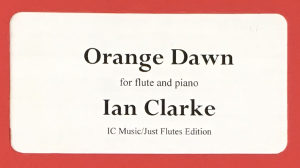
Now, I know, you people that have taken extended techniques to the nth degree probably think that was not a huge stretch. But listen, for me this was monumental!
It can happen, that when you first look at a piece with extended techniques out the wazoo, you might swoon or hyperventilate or just put it away for another day. When I first looked at all the alternate fingerings for the first page of Orange Dawn I about hyperventilated.
It is much like when I look at my little girls’ bedroom. I immediately close the door again and go about my business trying to erase that picture from my mind. Or I might have run the other direction screaming.
But like the first page on any piece, once seen, you cannot un-see it.
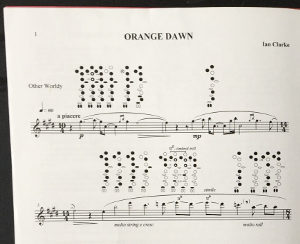
And so it happened that way with Orange Dawn. I realized that I wouldn’t learn it until I programmed it for a recital. We all know that once you have a program in mind, you go for it. So once it was “on the program” I knew I had to tackle it.
So yada, yada yada, I learned the piece.
And it wasn’t so bad.
What I learned was that you don’t work on the whole piece all at the same time. Much like my girls room where the only way to tackle it is to look at one corner and tell yourself “I can clean that corner…” Once it’s clean you look at another small area and clean that. Little by little the room gets cleaner. The cleaner it gets, the more enthusiasm you have to finish it.
And so it goes with any new extended techniques. Look only at one page at a time, not the entire piece. Conquer that one page. Then turn the page. In the end, you’ll find it’s not so bad.
When I got over my initial horror at the sight of the extended techniques in Orange Dawn, I had a great time with that piece. In this day and age you can find recordings of any piece you are working to help you understand what is the goal sound.
I was so energized by learning Orange Dawn, that for my next recital I programmed Zoom Tube!
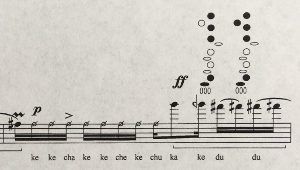
Let’s not talk about the joyous “yow” of all things, that made my blood run cold. But I did it! If you don’t know this piece go look it up. It’s great fun!
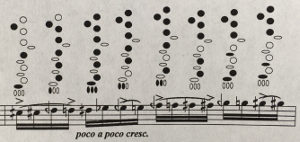
Now, I’m all in. ALL. IN. I’ll play anything. I beat-box, tongue stop, do weird multiphonics. I program these pieces for every recital whether in solo, or chamber. I’ve listed a couple chamber pieces that I’ve performed in the favorite things tab at the top.
Don’t be afraid! Join the revolution. Extended techniques are fun, fresh, and for everyone! You can do it.
Pick a piece and begin!
Have Fun,
DoctorFlute
The post Who’s Afraid of Extended Techniques? appeared first on DoctorFlute.
]]>