The post Concentration and Stamina in Your Playing appeared first on DoctorFlute.
]]>Let me give you a few pointers on what I wish I’d known in my younger years about how we can work on this area of performing. I used to think that it was really something that you just had to do. It was just a matter of willpower. And while it is a matter of willpower, there are ways that we can work on that self-control and that will, to achieve better results.
Know it Cold
One of the ways to work on this is to make sure that you know your piece cold.
Probably the first thing that I’ve had to learn in my career is to know a piece better than I think. Because the moment that you are nervous or the situation that you’re performing in is not optimal, then your concentration is affected. And if you don’t know your piece absolutely cold, then that’s going to invite disaster – flubs that you don’t necessarily need to have in your performance. But if you know your piece cold, you know the tempo, you know it faster than you want to play it, you know it slower than you want to play it, then you’re going to take that little bit out of the equation.
Play Through Difficult Spots
The second thing that I would say is learning to play through your difficult areas. And I mean, play through them. Oftentimes we take our difficult spots that cause us to flub up when we’re performing, and we just work on those flubs.
We do what I call the practice process which uses all the different articulations with your metronome on. I practice this way until I’ve learned that spot cold. But guess what? As soon as I do a play through with my piano player, that spot falls apart (at least it used to for me). The reason why that spot then falls apart, when I know it, I’ve learned it, I’ve done all the things that I need to do is because I haven’t learned mentally that I know it. So, in my mind, it still is a difficult area. What I must do is to erase the fact that that’s a difficult area from my brain and learn to play through that difficult spot without flubs. Then I will make new paths from my eyes to my brain, to my fingers saying, “oh no, it’s not a difficult spot anymore. I can play that spot.”
How Do I Play Through?
So, I learn to play through difficult spots. What this means is that I will add a measure before and a measure after the tricky spot – thus playing through it. However, you cannot start this until after you’ve done all your wood shedding, and you know that particular run or those particular measures that are tricky. Know them cold, then add a measure before and after. Then learn to play through.
Now you must play it through with your metronome on, because you don’t want to allow yourself the luxury of slowing down in those spots. When you have the metronome on it forces you to play through, hopefully up to tempo.
Plat at Tempo
And so I can put my metronome on the tempo and I can play the measure before the measure after, and I can play through that and I can do it again and again and again, and I can do it tomorrow with my flute cold, not having warmed up and I can play right through that spot because you’re teaching your brain a new path through that section because your brain learned the path that was wrong, that it was a flub area that you had problems now you have to learn that is not a problem area.
What you want to think about is that your brain no longer says, “that’s my tricky spot.” Your brain now says, “I’m just going to play because I know this piece, I can play it all the way through.”
Play Through a Section
After you’ve done that, played through with a measure before and a measure after, then I would go with a line above and a line after. Now you might want to say, well, what does it mean to play after? Because if I’ve gotten through that section successfully then I’m good right? Well, again, it’s teaching your brain how we think and how we learn. That section is no longer a problem. I no longer have to fear it and I’m going to erase that little niggly fear that comes in when I’m performing that says that’s a tricky spot.
Play Through a Page
Now’s the time where I might want to do the whole page. I want to play through the whole page with the metronome on. If you put that metronome on and you can play through that tricky spot, maybe another spot is revealed to you where you flub up and then you can mark that area and come back to it and start working on that. But it’s playing from top to bottom that is going to teach you how to concentrate all the way through and not allow yourself to have those flub areas. The areas that you’ve learned are tricky spots are more strongly erased and now we have no tricky spots.
Etudes Teach Concentration
Now the best place that I’ve learned to really work on that concentration and really stamina as well, meaning I can make it through a tough piece, keeping my brain on track and keeping my concentration is through etudes. The longer the etude the better. The Anderson etudes for example, get trickier and harder and more difficult as you go along. So, if you can make it through them concentrating, you can make it through a solo that will have measures of rest and places where you can put your arms down.
I am a big fan of etudes. But not just for technical skill and not just for learning music, but also because it really helps you to learn concentration and build stamina, when all the way through your metronome is on, you’re playing straight through. You are not allowing yourself to stop on those tricky spots because you’ve learned them and now your concentration is taking you through the whole piece.
Go get out a tricky etude and begin working on your stamina and concentration. It’s good work, it’s solid work, and you’ll be happy that you’ve done this kind of wood shedding and this kind of concentrated work.
Have fun!
DoctorFlute
Watch me demonstrate this idea:
Concentration and Stamina in Your Playing – FluteTips 162
The post Concentration and Stamina in Your Playing appeared first on DoctorFlute.
]]>The post Finding the Musical Line appeared first on DoctorFlute.
]]>When I was in school, I distinctly remember playing a lesson for my teacher Georgetta Maiolo. I came into that lesson with the Hindemith Sonata. I only played the opening phrase before she stopped me cold to tell me her story. She had been a child prodigy that premiered with the Pittsburgh Symphony Orchestra when she was 15 years old. She happened to be taking lessons from the principal who was also a professor at a college and that’s where the lessons were held. Now there was a method of teaching back then that would not fly today, but this is what happened. She went to her lesson and played the opening to Hindemith as I had done for her. However, her teacher threw a chair across the room and told her to get out and not come back until she could play that musically!
Georgetta had no idea what she did wrong. So, she left and went to a practice room until some kind soul came in told her what to do. This older student told her it was musicality that this teacher was listening for, and that meant the musical line.
I am very thankful that my teacher did not do that with me! But she did teach me that I was not playing the musical line. Even though I was playing all the notes on the page, I was not playing the musical line. Her story opened my eyes to see beyond what is on the page.
Finding the musical line is like reading a story in a schoolbook and then finding out from your English teacher that there are all these hidden meanings in that book. It is not just the story or the words on the page. When you are looking at your solo, you want to find that musical line because it's going to make the music more meaningful to you. It's going to add so much more interest for you, the player, but also for the person who is listening to your performance.
There are different ways of finding the musical line in your etudes and solos. Looking for regular phrase lengths or discovering that there are no regular phrase lengths such as in Baroque versus 20th-21st century music, can help you get started. If you are having difficulty knowing where your phrase is going you should listen and follow along with your music. Mark where your ear tells you the musical line is moving to. If you can find where the phrase comes to a cadence, mark those spots. With these markings you can then practice following along with your markings.
Consider the opening of Mozart Concerto in G. Now in the opening, it is easy to know where the phrase is going, because there are 3 beats, rest at the end of it. That is the beginning of my phrase map. Then I want to look and ask what are the predominant notes? Here the predominant notes are one and five or G and D and then we end on a B, so G B D and the chord.
Now, every solo that you have, especially if they're in 20th, 21st century, are not going to stay in that key, or outline the chord so nicely. So, then you need to use visual or oral cues to figure the phrase out.
It is your job to figure out what you want to bring out, and where you want to aim for in your phrases. It is perfectly fine for you to have a different idea of a phrase than I do. Maybe you hear something slightly differently. That's why musicianship is a fantastic thing and why three different performances will give you three different ideas of what's important in that phrase. You can decide what idea you like and go for it.
So, that is why you need to find the musical line. To play musically, you must play with that musical line in mind, so that you are not just playing the notes on the page. You are making music.
Have fun!
DoctorFlute
Watch me demonstrate this:
Finding the Musical Line - FluteTips 145
The post Finding the Musical Line appeared first on DoctorFlute.
]]>The post Always Warm Up Musically appeared first on DoctorFlute.
]]>Now I could play my scale study up and down until next week without even thinking about them. If you were listening, you would say that I did them well. That is, they served their purpose of warming up the muscles of fingers and lip. But what about the music? Should I even play anything if I do not play intentionally musically?
You Perform as You Practice
The bottom line is that if you play your exercises musically, this musicality will carry over into your solos. So, since you do want to perform your solos musically, then you should practice your exercises musically.
Let’s face it, warm-ups are the foundation of everything we do on the flute. It is here where we begin to pay the piper. Work on these seemingly insignificant exercises with intentional musicality, and you will go a long way to making music in your etudes and solos and ensemble music.
But Scales are Boring
The next question is how do you make boring scales interesting? You need to look for a way to shape these scales going up and going down. If you were to think of these the same way you would look at the same type of passage occurring in say a Mozart concerto, how would you play it? Where would you emphasize a note (maybe at the top), and that arpeggio might need the first note to be brought out.
Each scale exercise is different and can be phrased differently each time you play. That is a great exercise to change up the musical line of that scale to help you hear something you perhaps have not heard before.
Where’s the Music!
I played an unmusical scale one time for a teacher. She immediately stopped me and exclaimed “where's the music? What are you playing? Where's the music to what you're playing?”
At the time I didn't really know what she was talking about. She worked with me and taught me how to make music with everything that I play, not just with solos. It was a fantastic lesson to learn.
This teacher also taught me to listen to my articulation when playing scales. She always had me play my scales with all the Taffanel and Gaubert articulations. But I didn’t always phrase these articulations. So, she had me slur a section first. Then she had me do the articulation, but make it sound like a slur. This was an eye-opening experience. It made me realize what a musical phrase should sound like. It really did change me and my playing.
Play Arpeggios Musically?
How about arpeggios? Can you play them musically? Absolutely! I love playing Reichert’s 7 Daily Exercises no. 2. It is an arpeggio exercise that moves between an I chord and V chord. It can be played musically phrasing each chord as it leads into the next. Additionally, every time you play that exercise, it can be phrased differently, thus giving you something to think about, and keeping you focused.
It makes me have so much more joy in playing that, because I find that I'm not mindlessly playing just a scale exercise or just an arpeggio exercise that doesn't mean anything. Now I feel like everything means something.
This Becomes Automatic
The benefit to this type of intentional musical practice is that when you run across parts of these exercises in your solos, you will automatically play them musically because you have learned to play them musically.
So that's my advice to you for today. Start your next warm-up session with a musical warm-up because playing musically is much more interesting for you, the payoff is great, and you'll be much more interested in doing those exercises, if you make them musical.
Have fun!
DoctorFlute
Watch me demonstrate this:
Always Warm Up Musically - FluteTips 144
Why You Should Be Practicing Etudes Every Day – FluteTips 121
What to Do in a 30-Minute Practice Session – FluteTips 119
The post Always Warm Up Musically appeared first on DoctorFlute.
]]>The post 30-Minute Practice Session Using Mozart Concerto in G appeared first on DoctorFlute.
]]>It does take a little bit of creative work. But it can be done. The benefit you gain is that you are learning your solo while you are practicing.
Technique
I am going to begin with technique which means scales and arpeggios. Guess what? Mozart concertos are chuck full of scales and arpeggios. To begin, notice that this concerto is in G. That means I will begin by playing my G major scale, I want to know the G major arpeggio, and I want to play the G major scale in thirds.
Play though your G major scales then play it in 3rds. Then play the G major arpeggio. Get comfortable with the scale in 3rds it’s a great way to practice you scales. Play these until you whip up and down the scales like no bodies business. Additionally, play the D scale 3rds and arpeggios. Because on close inspection, there are places where Mozart moves to the dominant key of D major.
This G major concerto, as in many classical pieces and concertos like this one, is largely based on scales, arpeggios, and scales in thirds. So, if you know those cold, so much technique will be easy for you.
After I’m done playing scales and arpeggios, I will look in the concerto itself and find scales passages or arpeggios in the music. Take a couple sections at a time and work on the scale patterns Mozart uses. Put your metronome on and make sure you are even. Sometimes the scales aren’t just straight up and down. But you are looking for sections of adjacent notes. When you have those under your fingers, find another couple sections and work on those. After that, do the same with arpeggios. Mozart uses arpeggios.
This is the approach for technique. I’m sure you can see where I’m going with this and you can easily apply it to your own practice.
Tone
You are now warmed up after all those scales and arpeggios. Now it is time to work on your tone. So, let's look at the second movement. We'll do a couple of things with practicing tone at the same time as your solo because we've only got 30 minutes. So, let's look at the solo in your second movement. It's a gorgeous movement that you can use for tone practice. Let’s begin by taking out the first five notes to use as a tone exercise.
First, I’ll take that A at the beginning and play it until I get the tone that I want. Then I move to all 5 notes to play very slowly compared to how I would normally play it. Am I smooth? Are there any glitches? How is my vibrato? Am I tapering at the end? How is my vibrato going through that taper? Am I keeping my embouchure open so that the tone sounds mellifluous and beautiful? Now perhaps I will move on to the next group of notes and do the same thing.
Flexibility/Articulation
Now, another thing that I like to do when I'm doing a 30-minute practice time using a solo such as this Mozart Concerto in G is to work on my articulation and my embouchure movement.
So, we've covered technique. We've covered tone. Now let's do some articulation because we need to practice articulation and embouchure flexibility. In the first movement there are some great spots where Mozart wrote articulated octaves. He wrote then in 8ths, triplets, and 16th notes. These are great spots to work on that embouchure and its flexibility. Take those sections out of context. Play them with the best tone and do the octave jumps maintaining that sound. Work on short crisp articulations at the same time.
Etude
This entire concerto can be considered an etude. Etudes usually work on a specific area. And this concerto does the same thing. Using all the 16th note passages and practicing with the metronome, and using lots of different articulations is exactly what you would do in an etude. Once done you put those passages back into context and work on the musical line and phrasing.
Solo
Well now you can finally work on all the little spots that didn’t fit in with your other categories. Here is where you play a section and listen for continuity and other spots that need work. But you know what? All that other work pays off here.
So that's my advice. If you have a very difficult time eking out that practice time, try this method. Use your solo, use it wisely. You can learn your solo and improve all skill areas at the same time!
Have fun!
DoctorFlute
Watch me demonstrate this: 30-Minute Practice Session Using Mozart Concerto in G - FluteTips 134
What to Do in a 30-Minute Practice Session - FluteTips 119
How to Warm Up in 15 Minutes – FluteTips 152
Using Your Practice Time Wisely – FluteTips 156
The post 30-Minute Practice Session Using Mozart Concerto in G appeared first on DoctorFlute.
]]>Is practicing etudes a drudgery for you? Do you intentionally skip playing etudes? If that is you, I’m here to tell you to stop! Etudes are part of a rigorous practice session and reveal so much of what a musician needs to learn.
Etudes can be the bane of your existence, or they can be the gateway to playing well. There is a lot to be learned from etudes. But there are so many people that don't understand the benefits of practicing etudes. I probably was one of them - way back when. There was a time when I thought that playing halfway through an etude was good enough. It eventually repeated, so who cares about that middle tricky section? Oh dear, I cannot believe that I got away with that! Only later did I realize that was erroneous thinking.
At some point in my flute education, I had a really good teacher that told me how to practice etudes. She didn't come out and say “here are the reasons.” Rather it was how she had me practice these etudes that taught me their strength. She helped me realize that there was music in etudes.
Then I Fell in Love with Etudes
Now I espouse that you can learn everything about music through an etude. I even wrote an article on this topic for Flute Talk Magazine. I have done seminars and workshops on this very topic, because it's near and dear to my heart.
An etude can teach you a myriad of things if you let it. So many of the students that I teach come to lessons without their etude learned. And then I proceed to take the etude completely apart so they realize that learning the notes is only one small part of that etude practice.
Now there are a lot of different etudes and I think every teacher has their thing with which etudes they love and want their students to learn. But I think we all generally agree that Andersen etudes are at the top tier of etudes. They run the gamut from ones that I would do with an intermediate sixth grader to ones I would have a graduate student play. Plus there are Kohler etudes and there are Druet etudes and scads more. It is not totally about which etude you are playing, just make sure you are playing etudes.
Etudes Harp on Technical Issues
I want to give you some other reasons why you should practice etudes. I have this list of accomplishments that can be achieved through practicing etudes. This list came about because etudes changed my flute playing life. They really did. It was not playing solos that changed me as a flutist, it was etudes. We all know that etudes harp on a technical issue and they harp on it for line after line and sometimes page after page. You can have Andersen Etudes that are two, three, four even six pages long! When the composer targets certain aspects of playing that you get again and again and again and again what a phenomenal way to build your technique… if you are practicing it properly.
This brings me to the first point: etudes can build your technique. I wish that I had known this when I was younger because I would have had better technique at a young age. But for all of us at any age better late then never.
Learn to Practice Perfectly
The second point is to practice perfectly every time. Do not allow yourself to practice, go back and fix, and then re-practice. There is a way your brain works that when you practice you create a pathway every time you learn something and if you learned it wrong first then that path is now going the wrong way. You then have to re-practice correctly so many times in order to fix that wrong path even if you only played it once. Practicing perfectly is very important. This means begin slower. Do not allow yourself to have a mistake. Do not allow that to even happen one time. It takes a lot of discipline to do that, but it is very good, especially if you're planning on a flute playing career. With this method of practice, you will be happy when you're performing on your first recital that you've learned how not to play mistakes even that first time.
Practice with Articulations
Articulation is next on the list of what you can learn in an etude. Etudes have a myriad of articulations, often it is the same articulation that is being worked on in that particular etude. Placement of the tongue when you articulate is especially important. Learn how to get tone at the same time as you articulate. Putting your tongue in the right spot is a phenomenal thing to work on. We do not practice articulations enough. Part of technique practice that I have students use, is the 10 different articulations found in Taffanel and Gaubert's 17 Grand Exercise for the Flute. I have students practice etudes with many different articulations, not just what is written. This method can then be applied to solo practice. Technique can be learned if you use your metronome and 10 different articulations. Practice with articulations while you are learning your etude. It really helps to learn, and it is a strong way to practice.
Work on Tone
How about tone? Can you work on tone in an etude? Absolutely! When you are looking at your etude, and I think Andersen are especially wonderful in this, there are melody notes hidden among the myriad of technical notes. Practicing those melody notes you can work on tone. I think all Andersen etudes could be used in solo festivals. They are so phenomenal. But I would work on tone with a student by pulling out those notes. When you work on focusing tone on a tiny, short note it can really help tone. Tone disappears often when you are playing an etude because we are so bogged down with all the technique. So, stay focused on tone when practicing.
Find Your Cadences
Musicality is really something great that occurs when practicing etudes. Phrasing, when you find that melody and realize it moves to a cadence. You learn to shape the melodies within the technique and find your cadences. I teach students to play that melody like it is the most beautiful thing and it is the only thing that you are going to play. Then your job is to play the etude up to tempo with all the phrasing to the cadence points. It is a fantastic workout.
Learn to Play Through
How about a less concrete reason: concentration. Learning to play with concentration is learning to play through without stopping. I was one of those who could have benefited from this strategy much younger. Concentration is something I battle when performing. Etudes are where you pay the piper and learn this skill. Practice by starting at the beginning of an etude (after you have already worked on it and know it) and put your metronome on at the tempo it should go. Now play through and pay attention and do not stop for anything. Do not fix a wrong note. Do not go back to catch something. Learn to play through. This a great technique that is often missed when working on etudes. Sometimes, when I have not learned an etude up to tempo but I’m half to ¾ the way I will put the metronome on and play with this skill in mind. Sometimes it takes more stamina and concentration at metronome speed 80 to play through the etude than it does at metronome speed 104.
These are several reasons why you need to be practicing etudes every day. I hope that you can see why practicing etudes can be so beneficial to all aspects of your flute skills.
If your teacher is not having your practice etudes, I do not think they would mind if you added them to your practice routine. You can find several at my website to download for free at the DOWNLOADS tab above.
Enjoy working on etudes. They should not be thought of as drudgery! Think of them as solos. Beautiful, wonderful solos that will make your playing rise to a new level.
Have Fun!
DoctorFlute
Watch me demonstrate this:
Why You Should Be Practicing Etudes Every Day - FluteTips 121
What to Do in a 30-Minute Practice Session
The post Why You Should Be Practicing Etudes Every Day appeared first on DoctorFlute.
]]>The post What to Do in a 30-Minute Practice Session appeared first on DoctorFlute.
]]>Life is rarely ideal by giving us all as much time as we want to practice. Instead, life is crazy busy. Whether it’s the job, family, too many classes and papers, or a combination of all of them, life can take away all of our practice time. This holds true if you are an orchestral musician or a college professor too. We all have the events in life that keep us from practicing. But there is a way to keep in shape while making progress on your solos.
What is this beautiful secret? Here it is: Use your solo as your practice.
Yep, I’m saying use your solo to practice all 3 areas of a typical well-balanced practice session: tone/technique, etude, solo. You can definitely learn your solo AND progress as a flutist by practicing only your solo.
Use Your Solo as Your Practice
Yes, you can use your time wisely and get a full practice session in only 30 minutes!
That is what this topic is about – making the most of your limited practice time.
We all have busy lifestyles without the luxury of enough time for practice. There is never enough time for practice. Except when we were flute majors in college and our schedule had built-in time to practice. I did not think so then. If you are a college student now, you probably think you are too busy to get enough practice time. But once you leave school, you will realize that while in school, you did have built-in time to practice. When you are out of school, working a job, trying to make time for your friends, raising a family, making dinner, taking the kids to soccer practice, and to music lessons (kids of music majors must take music lessons) your practice time becomes an absolute premium. So, when you finally get a chance to practice, then you need to make the most of that time.
I have gone through various iterations of what to do when I only have a tiny bit of time to practice. Sometimes that just means that I only run through all my scales and say that I am done! Life is very busy in my household. I have four kids. I have homeschooled them all. I teach at two colleges. I have a large private studio, I maintain DoctorFlute.com, and make videos for this YouTube channel. Life is busy. Those four kids have lots of activities. Finding time to prepare for a recital can be a little bit tricky.
So, I have come up with my plan, and it's based on the fact that one time when I was in music school and I was talking to one of my piano player friends, I was just flabbergasted when they said all they ever practice are solos. Here I was struggling along in my practice room with my Taffanel and Gaubert and my Marcel Moyse tone studies, and then my Etudes. Then finally, finally when I am all done with all that, I get to practice my five or six different solos that I was working on at one time.
Tone/Technique, Etude, Solo
How does that pianist get away with only practicing solos? I know that there are some Hanon and Czerny books that pianists use in their younger days. But from what I understand, piano majors at music school just work on technique within their solo practice.
That was a revelation to me. I realized that perhaps we flutists can do that as well. Is it ideal? Probably not. I would much rather have my practice time divided into my thirds with enough time to do my tone and technique, enough time to do Etudes and enough time to do my solos. But that's not always reality once life hits.
Alright, now what? In any practice time, I want to start off with technique. Now there are the people who are tone people and others are technique people. I am a technique person. The first thing I want to do is move my fingers. I know other people who say the first thing they want to do is play a joyous sound. If that is you, more power to you! But it does not work for me. The first thing I want to do is get my lip going by moving. Because I just don't feel like I'm going to make that joyous sound unless my embouchure is warmed up.
Now in a normal practice session where you have lots of time, you divide your time into 3rds. Technique and tone are the first third of your practice; etudes are a third; solos the last third.
In my 30-minute practice session, I practice with a solo, and concentrate first on technique. For example, if my solo piece is the Bach C major sonata, to practice technique, I will begin with the 2nd movement as it is an Allegro where there are a lot of scale passages and articulations.
Warm Up with Technique
To begin with, I will take a few measures and set my metronome to a tempo that keeps me steady and perfect. Then I will use the Taffanel and Gaubert articulations to play through these measures. This gives me time to move the fingers, wake up the embouchure and practice articulations at the same time. Then I will move down the page practicing a few measures at a time. This is a fantastic way to practice technique and get warmed up.
Tone is next. When I am doing a short practice where I need to accomplish a solo at the same time, I don’t separate technique with tone. Once my embouchure is feeling good, I begin to work on tone at the same time. I listen to what my sound is like and then work on angle of embouchure and try to make sure that it is very relaxed. Next, I go to the slow movement and use that as I would long tones. I play through slowly, concentrating on my tone and generally doing the things I do when I play long tones.
Working on the solo this way includes “etude” practice, but you learn your solo at the same time. Use your 30 minutes and practice thinking your way through the solo. That is, approach the solo like you need to cover all 3rds of your practice time: tone & technique, etude, solo.
The difference between using a solo as your practice and taking a third of your time to practice a solo is in how you think about it. It is all in the approach.
I want to reiterate that this is not the ideal form of practice. Use this method when time is not your friend. When life is just so busy that you either do not practice or go right for the prize (the solo). It will work for you. You will stay in shape and learn your solos. Plus, it may help you keep your sanity when your life gets crazy-busy!
Have fun!
DoctorFlute
What to Do in a 30-Minute Practice Session - FluteTips 119
30-Minute Practice Session Using Mozart Concerto in G
5 Ways to Improve Your Technique Today - FluteTips 141
The post What to Do in a 30-Minute Practice Session appeared first on DoctorFlute.
]]>The post Playing Köhler’s Virtuosic Etudes Opus 75 appeared first on DoctorFlute.
]]>The Virtuosic Etudes are in fact virtuosic. At first glance, they do look a little bit scary. They are multiple pages long and very dense with notes. It just looks like a Köhler bled black all over the page and decided to make life difficult for the flute player. However, they do fit your fingers. That is, there aren’t any really odd or strange intervals such as the JeanJean studies. I wouldn't say the JeanJean studies are odd or strange. But they are different types of intervals and passages which don't fit your fingers.
Köhler's Virtuosic Etudes do fit your fingers. They're fantastic for making your fingers really move. Once you've worked on your technique by doing your scales such as the Taffanel and Gaubert scales or Reichert studies, it might be time to try these etudes. They will compliment the techniques that you're working on. It will be a natural flow to move from scale and arpeggio work to the Virtuosic Etudes.
If you would like to work on these then go to my website, DoctorFlute.com/downloads to download these etudes and start working on them immediately. They're fantastic. They're strong. They're not for the faint of heart. If you are scared by all the black, then don't start with these begin with something a little less black, then work your way here. But if you look at it and say, that's a challenge and I'm going to do it. Then these etudes are for you! Because you'll reap a lot of benefit from them. Keep in mind that they are not Anderson etudes where the melody shines through the melodic line amidst a lot of technique. There is phrasing and cadences to make these etudes musical as well as technical.
These etudes offer a challenge for anyone wanting to work on their technique with scales and arpeggios. They are well worth your time and effort for what they can teach your fingers. So, go to my website, download these etudes. You'll enjoy working on Köhler's Virtuosic Etudes, and then you can tell yourself that you're a virtuoso as well.
Have Fun!
DoctorFlute
Watch me demonstrate this: FluteTips 99 Playing Köhler’s Virtuosic Etudes Opus 75
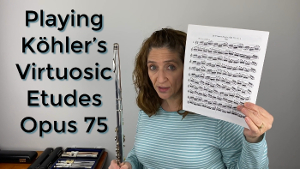

Practice with Me Dolls Waltz Köhler 25 Romantic Etudes Op 66 No 2

Everything I Learned About Music I Learned in a Etude!

FluteTips 14 Practicing Etudes

The post Playing Köhler’s Virtuosic Etudes Opus 75 appeared first on DoctorFlute.
]]>The post Getting Your Tone Back in Shape appeared first on DoctorFlute.
]]>So, now I'm getting back in shape.
I've been doing a lot of technical exercises because working on my technique is what is going to get me back into shape the fastest. But now it's time for me to work on tone. Now when I'm out of shape, I don't love working on tone because I feel like my tone is not there and we all love our tone. When you're in shape, it's wonderful to practice tone because you like your tone, and your lips can work on the subtleties of your tone. When you're out of shape, those subtleties aren't there and it's just depressing.
My embouchure muscles are still feeling like they need more work but they are beginning to respond. So, today I've done a lot of technical stuff and now I'm ready to work on some tone. I'm not going to go right into long tones. Instead, I'm going to take out Moyse’s book Tone Development Through Interpretation. I'll start in number 36 and stick to the low register exercises.
Remember that it's all about the embouchure, getting the lip to be flexible. When the muscles are out of shape, they're not going to be flexible. Just like in basketball, if you can shoot a hoop every time, and then you take a massive amount of time off, your muscles are probably not going to remember exactly, precisely how to shoot that basket.
It's the same thing with flute. Our muscles atrophy a little bit. We need to get them to remember what it is they're supposed to do. So, when I start this number low tone exercise, I'm not going to try to get the best tone I possibly can. I don't want to fight my embouchure that is a little bit out of shape. I want to play very lightly as if I'm doing one of Trevor Wye’s flexibility studies. I want to play very lightly. I want to hold my breath because I'm going to make my lip do all the work. Whatever tone comes out comes out. It's not my number one priority.
This exercise has a very narrow range but there are still some higher notes that work my embouchure. I need to get up close and personal with my embouchure. I'm also thinking about keeping that lip plate very light on my lip. I even pull it away ever so slightly as I play.
I'm going to do it very, very carefully, very lightly. I'm holding back all my air because a lot of times when you're out of shape, you tend to blow more air. So, just get used to holding that air in again, and getting the sound back slowly and carefully. This is going to do it.
When you're out of shape and you've done your technical exercises (I mean who can play tone exercises when you're out of shape? They're just depressing!) then begin to work your tone by playing Tone Development Through Interpretation and play only the low register. Play them softly and lightly. Hold in your air and make your lip do all the work. You will find that you get back in shape faster, and your lip will start working.
As I always say, slow gets you faster, faster.
Enjoy working on your tone and getting back into shape. It's not as depressing as you think.
Have fun!
DoctorFlute
Watch me demonstrate this Getting Your Tone Back in Shape FluteTips 89
FluteTips 88 Using Reichert 3 to Get Back in Shape
FluteTips 79 Single Tonguing to Improve Tone & Get Back In Shape Fast
FluteTips 61 How to Get in Piccolo Shape

The post Getting Your Tone Back in Shape appeared first on DoctorFlute.
]]>The post Practicing with Reichert’s Seven Daily Exercises appeared first on DoctorFlute.
]]>If you're getting a little bit bored with the scales that you're practicing now, this has got some new ones for you to use. Because it's not about just playing the scale. It's about interacting with the scale. The more ways that you can interact with that scale, the more it is going to benefit you in a great way. Now, that first, exercise that I just played is part of the first exercise. And what I like about that one is that it goes through all the major keys and all of the harmonic minor keys. So that was the key of F. then I would go into D.
And we're going through the circle of fifths. So, if that was one flat and the next one would be two flats and so forth. Now, the exercise number two is one of my favorites. It's not per se a scale exercise. It's an arpeggio exercise, but I think it's really good. It's good in that you're training your ear as well as your fingers. This one goes through each tonic and dominant chord. So, this is what it sounds like
And then you're supposed to play it up the octave too, and then you go into its relative minor and so on and so forth, and you travel through all the, keys and their minors. There's some really interesting ways to play your scales note. I really enjoy, number… there's nice chromatic scales is number six, where you're just going through all your chromatic scales, but I think it's number seven that I'm looking for right now. And this goes like this way.
It's really a fun exercise. It gives you a good chance to practice your triple tonguing as well. When it's all set in, in triplets and you have to decide whether you're going to go Ta Da K-TKT or Ta Da T- TKT or if you have a different system, but you, you know, you get to practice that and put it into place. The, so he's got some really neat exercises in these scales and it's well worth your time getting this book and using them as daily exercises. And I frankly like to use all seven as a daily exercise, whether he meant you to go through the whole book or just choose one as a daily exercise or two, I'm not sure his original intent.
But I think it's a great book to go through and just to play through all your scales. It's fantastic for your ear, it's good training and it mixes up the usual way of playing our scales and gives you some variety. So, check out Reichert's Seven Daily Exercises and start including that in your warmup routine.
You'll be glad that you did.
Have fun!
DoctorFlute
Watch me demonstrate this Practicing with Reichert's Seven Daily Exercises Opus 5 - FluteTips 85
Loosening Your Embouchure While You Are Playing – FluteTips 165

The post Practicing with Reichert’s Seven Daily Exercises appeared first on DoctorFlute.
]]>The post Single Tonguing to Improve Tone & Get Back in Shape Fast appeared first on DoctorFlute.
]]>Single tonguing does a couple of things. It forces your sound to come together in a tiny amount of time. It helps you to get up close and personal with your embouchure. You have think about what's going on in the muscles of the embouchure. However, you must be intentionally working not mindlessly playing.
To work on this I like to find single tonguing exercises and etudes that use single tonguing. Tonguing through Taffanel and Gaubert #4 or #5 is a perfect exercise. I love to tongue through Reichert's 7 Daily Exercises #2. This exercise is a pattern of arpeggios. It is fantastic for the tone.
In etdues I will often begin with Anderson Op. 41 #2 and then perhaps move on to 21, 33, 15, and 60 from there. In these etudes I play only the single tonguing exercises.
When I begin to practice I want to take that tongue, my air, and my embouchure and put them all together in the short little bursts to get my tone to focus. I might take the rhythm apart and not play in tempo. So, that I can think about what my embouchure is doing and the pressure I have on my lip. When I'm out of shape sometimes I add more pressure onto my lip. Which is exactly what I don't want to do.
Now I'll go back to the beginning and play it maybe more in tempo.
Additionally, when I'm out of shape I can get tight in my embouchure. I firm up the corners, when what I really want to do is loosen them up. Concentration with my short tonguing helps me here as well.
Another aspect of single tonguing is finding the right spot on the lip plate for your air to blow across. I fool around with where does that air hit. Am I going to hit the wet part of my lip? I love to do that with all these tonguing exercises.
There's so much instant benefit from doing a lot of single tonging. The finger work even helps to get your muscles get more into shape. But when you use them to focus on your embouchure, you tone improves, and you get back into shape fast.
Have fun!
DoctorFlute
Watch me demonstrate this: Single Tonguing to Improve Tone & Get Back In Shape Fast - FluteTips 79
Single Tonguing 3 Different Ways – FluteTips 94

Fast Easy Clear Flute Double-Tonguing FluteTips 111

Getting Your Tone Back in Shape

Using Reichert Number 3 to Help You Get Back in Shape

The post Single Tonguing to Improve Tone & Get Back in Shape Fast appeared first on DoctorFlute.
]]>