The post Flute Articulation – Focus on Your Tah appeared first on DoctorFlute.
]]>There are differing ideas on tongue placement, and I think they can all be used for various reasons. But I want to discuss the unfocused Tah sound. You know that one especially in the low register where sometimes it’s a puff of air rather than good tone quality.
Here are some practical tips to improve your tone quality by focusing your Tah when articulating.
- The Importance of Articulation Practice
First and foremost, let’s establish the significance of practicing articulation. It’s not just something you do in passing; it should be an integral part of your practice routine. Whether you’re warming up, working on scales, or diving into your etudes, incorporating articulation exercises is essential. Variety in your articulation patterns helps you develop versatility and adaptability in your playing.
- The Precision of the “Tah”
Let’s delve into the heart of the matter—the “tah” articulation. I often find that many of my students, even those at the college level, tend to use too much air when articulating. This excess air behind the tongue can lead to imprecision and a lack of control.
- Tongue Placement Matters
To master the “tah,” you need to pay close attention to tongue placement. Your tongue should be as far forward as possible without touching your teeth. This precise placement results in a sparkling, pointed articulation, which is crucial for achieving a clear and focused tone.
- The Art of Air Control
A significant part of achieving a well-focused “tah” lies in controlling your breath. The key here is to hold in as much air as possible when you articulate. The more control you exert over your breath during tonguing, the more precision and focus you can achieve in your sound. This results in a cleaner and clearer tone, as opposed to a vague dispersion of air.
- Monitor Your Stomach
To gauge your progress, you can use a simple exercise involving the observation of your stomach. If you notice your stomach contracting with each articulation, it’s a telltale sign that you’re releasing too much air. Using a mirror to keep an eye on your stomach and practicing to maintain a steady position will help you achieve a more focused and controlled sound.
- Practical Articulation Exercises
Practical exercises play a crucial role in your journey toward mastering articulation. For instance, pieces that involve a lot of tonguing, such as the Bach E-flat Sonatas, provide a perfect challenge. Focus on holding in as much air as possible while maintaining a precise “tah.”
- The Ultimate Goal: A Focused Tone
In the end, our objective is to achieve a focused tone that is free from excess air. With practice and control over your breath, you can ensure that your performance is characterized by a clear, rich sound.
In conclusion, I’ve found that paying attention to these aspects of flute articulation has significantly improved my playing. Whether you’re a beginner starting your musical journey or an intermediate flutist looking to enhance your skills, I encourage you to follow these guidelines. With consistent practice and a focus on your “tah” when you articulate, you can achieve better results in your flute playing.
Have fun!
DoctorFlute
*This blog article was edited by ChatGPT. What do you think?
Watch me demonstrate this:
In this video I discuss the exact position of the tongue necessary for a good clear Tah using embouchure, tongue, and support.
Let’s Talk Articulation – Focus on Your Tah – FluteTips 179

Practice Articulation to Improve Your Tone – FluteTips 155

FluteTips 38 Practicing Articulation

FluteTips 1 Articulation Tonguing Too Far Back

The post Flute Articulation – Focus on Your Tah appeared first on DoctorFlute.
]]>The post Resonate to Improve Your Tone appeared first on DoctorFlute.
]]>When we think about our flute sound resonating, we are talking making a tone that is vibrant and alive. When you use resonation to improve your tone, you will be surprised at how much you like it! A tone that resonates will make people stand up and take notice.
There are 3 places or ways to make our tone resonate. The first way is that we want our sound to resonate through our flute. The second place is we want our tone to resonate in our sinus cavity. The third place we want to resonate is through our body. And we want everything in our body to work towards getting that resonation.
Think about your favorite flutists and how they sound. They achieve that beautiful tone because they are resonating in these three areas.
Our Flute
It is very important for you to have the instrument that will do it for you. If you have a beginner instrument, you could still get a good tone. I have had many students who still get a really nice tone on a beginner instrument. But in the end, there is a limited amount of resonating that you can achieve on a silver-plated nickel instrument, if that’s your beginner instrument.
So, it might be time for you to upgrade if you have that beginner instrument and you’re really looking to get that tone, because who doesn’t want to practice more if you’re sounding really good? At minimum, make sure your instrument is in good shape, has had a clean-oil-adjust, and no pads are leaking.
While I’m not talking about embouchure and how you must put that in the right place and have the right shape embouchure on your lip plate. While that is important, we are just discussing resonating today.
Our Sinuses
How do you resonate in your sinus cavity? The main point of resonating in your sinus cavity is to open the back of your throat. Some of you can just do it when told. You just read it, tried it, and it worked. That is great!
But for the rest of us, here are some pointers. First think about what happens to your throat when you yawn. Go ahead, take a yawning breath. Feel how that opens up your throat. You want your throat to just open right up like that when you play. You want to feel that there are no restrictions that are going to inhibit the tone. You want to have that resonating sound echo through your sinus cavity. It can resonate when you keep your throat open.
Now, one of the ways for it to resonate in your sinus cavity is to make sure the back of your tongue is down and your soft palate is up. Practice yawning again and feel the back of your tongue pressing down; and feel the open space as your soft pallet goes up. When you yawn like this you create an open space in your sinus cavity for your sound to resonate. This is why I encourage my students to “take a yawning breath” because it opens up sinuses.
Now, if you are not thinking about this and working at it, it is very easy to close off your sinus cavity, which limits your resonation. So be sure that you are thinking about that tongue being down in the back, that your soft pallet staying up, and that when you take that breath, it just fills it right up.
Our Body
Now let’s talk about the third place for resonating, and that is through your body. So, when I breathe, I expand my rib cage and expand my stomach at the same time. Plus, when I take that yawning breath and I open my throat, all of a sudden when I am playing, that sound can resonate through my body from the floor all the way up to my sinus cavity.
So, I will stand not with my feet right together, but I’m a little bit firmer of a stance, having my feet a little bit apart. So, I’m very solid. I feel very grounded from the floor all the way up into this sinus cavity. It is all open because I put my whole body into it.
Now, for me, I know I am pretty good at this, but I will let the back of my throat close off. So, I must concentrate on that. I focus on it. I can hear the sound close off when the back of my throat closes. And I can hear my sound resonate more when I open it back up. You too may have something to focus on to achieve a resonant tone.
First, you want it to resonate through your instrument. So, make sure that your instrument is in good working condition. Upgrade if it is time to upgrade.
Second, the back of your tongue is down, your throat is open, and your sinus cavities are open.
Third, let the sound resonate through your body, all the way up into your sinus cavity through that nice hollow tube you have just created by expanding that rib cage, taking yawning breath, and opening your throat wide open.
Try that. Experiment with these areas and see if you can get that rich, warm, resonating tone that you are looking for.
Have fun!
DoctorFlute
Watch me demonstrate this:
Resonate to Improve Your Tone – FluteTips 178

You Can’t Have a Good High Register Without Having a Really Good Low Register – FluteTips 172

Getting Spin on Your Third Octave Notes – FluteTips 171

FluteTips 69 Playing Flat Scales to Expand Your Tone

Putting Air in Your Cheeks to Lower Your Pitch – FluteTips 32

The post Resonate to Improve Your Tone appeared first on DoctorFlute.
]]>The post How to NOT Go Flat at the End of Notes appeared first on DoctorFlute.
]]>It’s quite common when you run out of air or lose your support. But you can keep those notes on pitch even when you’re running out of air by working on tapers, keeping the airstream up, and keeping up the support – or what I like to call pressure.
What I am talking about going flat is when at the end of a long phrase or a slow movement you end up playing your last note flat. It does not have to be a slow movement it can be a fast movement too.
Now, there’s a couple reasons why a note goes flat, and it all has to do with how you are playing that last note.
So, we can have it go flat because basically we are letting it go instead of just keeping it like when you attack the note. When you attack the note, it could be right on pitch, but then somewhere along the way something changes, and it makes that note go flat.
The biggest reasons that it goes flat is that we are either running out of air, or lacking support.
Support
When we reach the end of a phrase, if we start to run out of air, and then we let go of that support we are almost certain to go flat.
Now I can be out of air but still keep the tone up as long as I maintain my support. I just have to think about it ahead of time.
Another reason why notes tend to go flat at the end of phrases is because along with the airstream dying and the lack of support, we allow this embouchure to lag and that means the airstream starts lowering. It just comes down and whenever you lower your airstream, you are going to bring the tone down.
Airstream
Sometimes lowering your airstream is a good thing. For example, if you are sharp in an ensemble and you need to bring the tone down, you cannot necessarily always be adjusting it with your headjoint. You can just lower that airstream without lowering your head, and then you can keep that good sound but get back on pitch.
So, if I keep my air support and up and I keep my airstream up, even though I’m running out of air, I am still going to keep that note in tune.
Tapers
Now one of the things that you need to do, and you need to be doing this on a regular basis, is practicing your tapers. Tapers are how you end notes. I’m closing my embouchure, bringing my jaw out and tapering that sound right off.
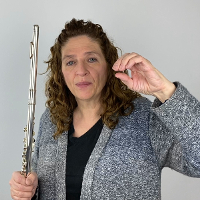
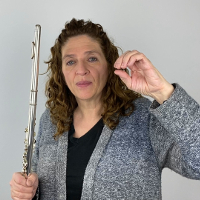
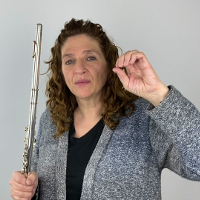
If I bring it up as I’m tapering that note, my airstream is going to stay right up where it needs to be to maintain the proper intonation – to not go flat.
When we allow the note to just end without tapering, even if you didn’t jump down the octave, if you’re just doing it by your air, your airstream is going to lower and then you’re going to be flat.
So, keep your airstream high. It’s all about keeping that airstream high, keeping that air pressure up, keeping your airstream higher, and then using your taper to end that note.
All those factors will work together to keep that tone at the end of your phrases right on pitch. And that’s how you don’t go flat at the ends of phrases.
Listen to yourself playing and tell yourself to keep that air pressure up, even though you are running out of air, keep the air pressure up, and your tight muscles can keep that note, uphold that note, right in tune. Just because you run out of air does not mean you have to go flat.
Try it. Experiment with these things. Practice your tapers and you’ll find that you can fix going flat at the end of phrases.
Have fun!
DoctorFlute
Watch me demonstrate this idea:
How to NOT Go Flat at the End of Notes – FluteTips 168
Evening Out Your Registers – FluteTips 169


FluteTips 11 Support – Ribcage Air

The post How to NOT Go Flat at the End of Notes appeared first on DoctorFlute.
]]>The post Playing with an Open Throat appeared first on DoctorFlute.
]]>Have you ever asked that question? We have all felt that way some time or another. It can be quite discouraging to try to do everything correctly, but still not quite have the tone you want. Sometimes though the answer is right there waiting for you.
Have you ever considered the role your throat plays in your tone?
It is not always what comes to mind in correcting tone. However, it can be the missing piece that keeps you from the best tone.
I’ve talked about how playing with an open throat can improve your tone, but I want to talk just a little bit more in depth. More specifically I want to discuss how your throat starts closing while you’re playing and how breathing can interfere with keeping that throat open. The best way to do this is to talk about that within the context of a solo. I suggest that you take your breath as a yawning breath and concentrate on opening the throat. The goal is to open your throat all the way up to your sinuses.
However, many times as soon as you begin to play, the back of the throat, right at the top where the tongue meets the throat, closes right back up. When that happens, the tone becomes tight, and the closed throat interferes with the direction of the airstream. Thus, the airstream can be shaky or even spotty. It comes in and out affecting the tone by interfering the with it. So, when you’re playing take notice of your sound and see if there’s anything that interferes with that straight flow of the tone.
There have been numerous times helping students with their tone, when they seem to be doing everything right, but they still do not sound like they should. Then I finally remember the throat! We then experiment and 9 times out of 10, that fixes the problem. Remember that for yourself, that you can be doing everything right by having that natural embouchure and you can be open with good support but if your throat is tight, it squeezes your tone.
Another indication that you have a tight throat is what you sound like when you breathe. Do you hear your breath? If you hear a gasping sound when you breathe, your throat is tight. A free breath that keeps the throat open is nearly silent. A silent breath ensures that your throat is open and your mouth cavity is open.
Another thing to address is tightening while you play. There can be times when you perform, and you begin with a nice open throat, but your throat begins to close the longer you play. Every time you take a quick breath in the music you get tighter and tighter. All it takes to fix this problem is training yourself that every time you take a breath, open the throat, take that yawning breath. It is just as fast as that gasping breath. Our head tells us that it will waste time to open up the throat for a good deep breath, that we will lose time – it just cannot be fast enough. But it is just as fast.
I had to train myself to take that quick breath from below and open up the throat. It is not natural for me in the thick of it to take a yawning breath. I still work at it. I practice stopping when I need a breath and actually take a good one. Even if that means it breaks up the flow, because I am training my body to breathe this way.
How about you? Is your throat tight? I want you to listen to your tone and see if maybe you are playing with a tight throat. You will sound fantastic when you open that throat and have a free tone.
Have fun!
DoctorFlute
Watch as I explain the role of your throat and how to fix it to see if this is the missing piece to improve your tone:
Playing with an Open Throat – FluteTips 148

Improve Your Tone by Opening Your Throat – FluteTips 56

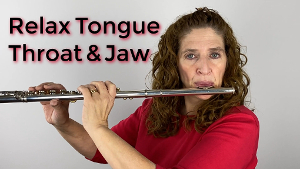
Relaxing Your Tongue Throat & Jaw When You Play Flute – FluteTips 118

The post Playing with an Open Throat appeared first on DoctorFlute.
]]>The post 5 Things That You Do That Can Ruin Your Flute Tone appeared first on DoctorFlute.
]]>In this blog I will teach you 5 things that you could be doing right now that could be preventing you from achieving that great tone. I will explain to you what the problem is and then teach you how to fix that problem.
Problem # 1
Too much pressure with your lip plate to your lip. Think about this and then play and see if this is your problem. Do your press the flute into your lip with a lot of pressure? If someone cannot use one finger to gently pull the flute away from your lip, then you are pressing your flute too tightly to your lip.
When the lip plate is pushed too hard against your lip, your lower lip will cover too much embouchure hole. The tone then goes straight into the flute and keeps the tone covered. Your goal is to let the tone out and not keep it in.
Try loosening up when you play. The issue is usually the left hand first finger is pressing too hard. When you let up, you will be surprised at how much more comfortable it is to play. The tone relaxes as well and can come out.
Your air needs to be split by the strike edge at the right angle for optimal sound. When you cover too much embouchure hole you cannot use that strike edge to split the sound the right way.
Problem # 2
The mouth cavity is too closed. Or more to the point, everything is closed. That means that inside your mouth, your lips, your teeth are too close together. Being tight and small is really ruining your potential.
If you were my student, I would work on learning to open up one step up at a time. Here I’m telling you what to do all at the same time, but I would suggest that you take one of these at a time and work on it.
Here goes:
Open your teeth
Open your lips
Open your mouth cavity
When these areas are closed your tone is small and tight. It is amazing that when you open up your teeth, lips, and mouth you can fix your tone immediately. Your tone opens up and becomes bigger immediately. It is miraculous.
Problem # 3
Being rolled in too far.
During an online lesson, I noticed that my student was rolled in too far. Online lessons are great in today's environment. But it is a little bit more difficult for me as a teacher to see how much a student is covering the embouchure. It took a little bit more creativity for me to see but, I was able to figure out that she was indeed covering too much of that embouchure hole.
Her problem was that she was playing with her head down. With the head down ¾ ths of the embouchure hole was covered. When she raised her chin, it was amazing how much her tone opened up and sounded so much better.
Another problem that got fixed by lifting her head was intonation. When you cover too much hole you are often flat. When I’m looking at the student straight on, I generally want to see the outer edge of the tone hole. So, if you look in the mirror, you should be able to see the outer edge. If you see too much hole, you have rolled out too far.
Problem #4
You don’t change your embouchure in different octaves. Our embouchure is not set in stone. It can change and it needs to, absolutely needs to change depending on the octave you're in. When in the low octave, I'm going to use my low embouchure and change when I'm in the higher octaves. My embouchure needs to be flexible. It needs to move.
My jaw should always be in a state of flux. It moves so that I can get the low register. I remember in high school and even in those early years of college, where I would play a piece and I thought halfway through that piece in that I was performing, my low register was gone. I got nothing, but puffs of air. I'm sure something came out, but it wasn't great. It wasn't until I really did this embouchure exploration and learned how my embouchure could be flexible that I realized it's because I was keeping a high embouchure when I needed to change to a low register.
Problem #5
Blowing too much air.
I can’t tell you how many people I have that the answer to their tone problems is they are blowing too much air. Until you learn how to hold your air in, by support, you will not have the sound you want. Air pressure is the key to holding the air in and not let it come out. Learn how to take that breath and hold that air and tighten up those muscles and keep the air locked inside to control the pace of which that air comes out of your embouchure.
Those are just five reasons that ruin your tone, and you can fix them all today. They are not long hard techniques that take a long period of time to fix each one. If you feel like all five of those are a problem for you, work on them one at a time. You will see that you can get control over your tone and start having a fabulous sound.
Have fun!
DoctorFlute
5 Things That You Do That Can Ruin Your Flute Tone - FluteTips 136

The post 5 Things That You Do That Can Ruin Your Flute Tone appeared first on DoctorFlute.
]]>The post Controlled Air Stream appeared first on DoctorFlute.
]]>Sometimes it is clear that the air is having its own way. At other times we do not even know that we are not in control of that airstream. A non-controlled air stream can be hidden in a nice tone. Just because a tone is clear does not mean that you are in control.
I would suggest that you record yourself. With today’s technology it is easy to record and then listen to yourself very carefully. What do you hear when you listen? Is your tone a smooth sound that expresses the music beautifully? Or do you hear times where your air surges through your tone and becomes a little obtrusive? If you feel that your air surges forth when uncalled for, then your air is not under control.
Your goal is to have a steady stream of air throughout a musical line. This requires you to have control of every drop of air that comes out!
I would bet that a lot of you have intermittent air surges to some extent. What I mean is that some notes have just a little bit of an explosion of air. However, you need to be in control of your air stream. And you can learn to get control!
The way to control your air is through what we call support. Doesn’t it feel like everything goes back to support? When we are talking about tone, support is the foundation of everything we do. So yes, this issue is a support issue. What is your support doing? If you are not in control of your air, it is probably because you are not controlling your support. Take a breath from your stomach and your rib cage and tighten those muscles. Make sure that your throat stays open when you take that breath – a yawning breath.
I had a student who could not figure out why her tone was not going in the right direction when it seemed like she was doing everything correctly. We finally figured out that her answer was to loosen her throat. Once she opened that throat up, then all the control that she had practices just came through beautifully in the pieces that she was playing.
Now try playing with those tight muscles. Control how you use that air. That is, only let out the air that you need. Create an atmosphere around that sound. It is smooth and alive. If not, then too much air is coming out at one time. When you are in total control of your air, there may be times when you may use up your oxygen and must let air out before you can take a breath in.
If you know Debussy's Afternoon of a Faun, then you know, that here you need absolute control. Any uncontrolled air will ruin the color of this beautiful solo. The current thought is that you do not have to do it in one breath. But for all my life anyway, the standard has been doing that in one breath. For me that is a really difficult thing. If I am going to play that in one breath, I have to control absolutely every aspect of it: where do I add vibrato? where do I change the color? what exact beat do I start putting more dynamic on? I need to plan exactly where I do all those things in order to make it in one breath. When I have complete control of my air, I can play it. But when I let out too much air, I am a goner.
If you are playing a slow movement, listen to yourself, maybe record yourself and see if you hear any of that undulation. Is your tone coming in and out? Are you getting louder for no apparent reason? If you are getting louder because you want to get louder, that is completely up to you and your musical taste in the piece you are playing. But are you just unknowingly fluctuating your tone? How about vibrato? Are you controlling it?
After analysis and practice, record yourself again. Then compare the two recordings. What do you sound like? Keep practicing until you hear improvements. They will come.
Like so many aspects of flute playing it all goes back to breathing. You have to have your pressure built up inside by tightening those muscles and being in total control with how fast you use that air. If you do not tighten those muscles, you can breathe from your stomach all you want, but you will not have support without that pressure built up. It is the tightness built up with those muscles that enables you to control how much air you are using. Only now will you create an absolute, phenomenal sound, atmosphere, and musical line. Think Debussy's Syrinx, Mozart Concerto, slow movements or any other slow movement and work on having total control.
So have phenomenal support and use recordings of yourself, listen, and see if you are in control of your tone, or are you fluctuating that airstream?
Controlled air, that is where it's at.
Have fun!
DoctorFlute
Join me and watch as I explain how to control your air stream:
Controlled Air Stream on the Flute - FluteTips 129

Finding Color in Your Musical Line - FluteTips 146

Faster Air vs Blowing Harder on the Flute – FluteTips 128

The post Controlled Air Stream appeared first on DoctorFlute.
]]>The post Faster Air vs Blowing Harder appeared first on DoctorFlute.
]]>Or perhaps a weak it depends. Should they be the same thing? I can definitively say no they should not be the same thing. But sometimes they are the same, based on your interpretation.
Blowing harder is what every beginner student does in every register. They use too much air blowing and consequently get a bit dizzy from too much oxygen to the brain. Do you remember getting dizzy when you were learning the flute?
As you get older, regardless of private lessons, you usually learn to adapt to the amount of air needed. Generally, the 3rd octave gets way too much air. When this happens, the embouchure has to compensate for that amount of air, by becoming very small and tight. Yes, your 3rd octave will respond. But what are the problems? The tone is thin, the dynamic range is small and there is no color change that can happen.
High note success is built on fast air and a relaxed embouchure all wrapped up together.
The key to all high notes is the trilogy of embouchure, support, and air speed. The embouchure has to stay open, loose and remain free of tension. When support is then added, the embouchure is free to stay open and the air speed can quicken and stay steady. The problem is that students have difficulty making this trilogy work together. The result is faster air becomes blowing harder which then necessitates the embouchure to tighten to control that air. It is a sticky wicket!
Have your teachers used the term faster air? The term is usually used when referring to the speed of air needed in the 3rd octave. The speed of the air needs to increase in order for the 3rd octave notes to come out. If the air stream is not a certain speed, you will only get notes from the lower two octaves. Faster air is needed to maintain a steady 3rd octave note. We do not want to change that fast air to blow hard – as blowing hard indicates a lot of air expelled with no control except with a tight embouchure.
In truth, I do not use the term faster air, nor do I use the term blow harder on a regular basis. When I use the term faster air with younger students, their response is to blow harder. I don't want them to blow harder, but they don’t know what fast means.
Another thing that a young student will do if you tell them to use faster air is they will blow harder and pinch the embouchure. It does produce a purer sound, so they think that is great! But because it is such a small hole that the fast air is going through, all they can get is a tiny sound. The dynamic levels are very limited from a forte to a piano.
High note production must have the embouchure be open. It must have a lot of air pressure pushing up on the high register so that your embouchure can stay relaxed. If you do not have support (air pressure) then your only recourse for control is for the embouchure to shrink. It is going to get tiny and tight.
I know that as you get higher your embouchure does shrink, but you know what? I am never going to say that to a student, because if I do, they will go to the extreme. They will concentrate so much on their embouchure that it will get small and tight. However, if I tell them to keep it open, just make the air faster and use a good push from support, then generally they do the correct amount of everything.
Experiment with blowing harder and keeping your embouchure open. Do you like what you hear? Probably not. When you blow harder you do not have any control. This is why everybody tightens up when they blow harder. The good stuff happens when you keep that embouchure from shrinking because you use so much support. You know what will naturally happen? Faster air. It will naturally happen. But if your high notes want to go low, think a little faster and that problem will go away. Can I control that air? Absolutely! Because of that air pressure, your embouchure is free to control forte and piano.
Practice in front of the mirror to see if you are pinching. You can identify if your embouchure is tight. Does it look like you do when you have a natural closed mouth position? You do need to change your embouchure, but can you keep it as natural as possible?
Sometimes I like the term “intense” to better describe the air stream for high notes. If I use the term intense air stream, then we can take the “faster” and “blowing harder” out of the equation.
So, your job is to find out if you are blowing harder, or if you are using faster air. If you are blowing harder, you can tell because blowing harder means you have to pinch. If you use the faster air stream or a more intense air stream and a lot of support pushing through there and keeping your embouchure as open as you can, then your sound can be beautiful. It can come out free and unencumbered because there is nothing that is pinching it.
If you are blowing harder, there is no control except to pinch. Use the mirror. The mirror will tell you. But some of you already know, when you play high notes for too long, then your embouchure starts getting tired. If it gets tired, you know that you are doing it wrong. Barring a few really long high pieces, I probably could play all day long without my embouchure getting tired. The only thing that gets tired are my arms holding my flute up.
Is blowing harder your problem? Are you pinching when you play or are you staying open with that relaxed embouchure making your air stream a little bit more intense?
Have fun!
DoctorFlute
In this video I will teach you how to use faster air to gain the high register with control and without blowing harder or tightening your embouchure.
Join me and watch as I explain how create the tone you want using faster air:
Faster Air vs Blowing Harder on the Flute - FluteTips 128
Controlled Air Stream on the Flute - FluteTips 129
Finding Color in Your Musical Line – FluteTips 146
The post Faster Air vs Blowing Harder appeared first on DoctorFlute.
]]>The post Playing Through Your Double Tonguing appeared first on DoctorFlute.
]]>One of the ways to clean up your double tonguing is to play through the tonguing. Often when double tonguing the air is chopped off. The tonguing then becomes very choppy, and it is tiring to do. When you learn to play through your double tonguing with your air and your support, then you free your tongue and fingers to move quickly.
The biggest problem I hear when people are double tonguing is this way of stopping the tongue as it moves between your ta and your ka. I call it the henpeck. Now there are other reasons why double tonguing can be kind of henpecking. But the tongue stopping the air is the biggest reason double tonguing does not sound effortlessly smooth.
This occurs because we do not play through the double tonguing. Playing through the double tonguing means you take your breath, add support (what I call air pressure) and then keep everything (throat, embouchure) open - as you double tongue. Make sure that you are continuously keep air pressure on the tongue. However, the tongue must remain light. Now it does not mean that I'm blowing extra air. Blowing harder and keeping air pressure are not the same thing. I still want to have total control over my air.
When I use a lot of support, I breathe from my stomach and my rib cage, and I expand them, and then tighten the muscles. I make sure that when I say ta-ka-ta-ka-ta without the flute, that air pressure is still present. Try it yourself. Remember that your tongue releases the air it does not stop the air. Now try it on the flute. Play one note and practice 5 doubles ta-ka-ta-ka-ta. Do the doubles flow easily, or do you let your flute playing change the way you say it without the flute?
Midsummer Night's Dream is a fantastic piece to practice and learn double tonguing correctly. Most of the time when I hear students play Midsummer, they chop the tonguing completely. When that happens, the light flow of the music does not happen. It does not have that beautiful musical flow. One way to help practice double tonguing correctly is to practice the passage slurring first then double. When you double tongue, you want it to sound as if you were slurring. You want the same flow.
Practice your double tonguing. Keep it very light with an air stream flowing through. Keep the throat open, take that yawning breath and maintain air pressure so that you can stay steady.
Do you know a weird thing? Air pressure helps you hold on to that beat, so that your fingers do not rush. I do not know why it works. It just does. It really helps to hold on to that beat. You feel like air pressure or your support holds on to that beat, so that you do not rush. Then your fingers and your tongue do not fall out of sync.
So, hold on to that double tonguing by air pressure, open up your throat, and keep your tongue light. When you do, you will find your Midsummer Night's Dream or your Mozart Concertos flow beautifully like the professional sound you're going for.
Have fun!
DoctorFlute
Playing Through Your Double Tonguing on the Flute - FluteTips 127

The post Playing Through Your Double Tonguing appeared first on DoctorFlute.
]]>The post Playing Flute Without Tension in Your Tongue Throat & Jaw appeared first on DoctorFlute.
]]>Tension is one of those areas that we all need to work on. Tension in the embouchure can prevent you from getting the sound you would really like to have. The problem is we don’t work on this. It is oft times ignored in our practice sessions.
I want to encourage you to figure out what is happening in your areas of tension especially as they pertain to the embouchure. Special places of tension are in the tongue, jaw and throat. These tension filled areas prevent you from having the sound you want to have. Tension locks the sound in the mouth instead of letting the sound come out through a relaxed embouchure.
When you begin to work on relaxing the throat, jaw and tongue then your sound begins to loosen up and can then begin to soar.
Tongue, throat, and jaw tension are something that can plague us throughout our flute-playing existence. If I am especially tired or a little bit out of shape, the first tension that I feel is in the jaw. After that, it shows up in the throat. It drives me crazy that when I need to have tension-free playing my jaw and throat tighten right up. This then gives me a tight tone. Then I get mad because my tone is tight, which in turn makes me tighter… it is a vicious circle.
Jaw tension leads directly to throat tension. Show me someone with a tight jaw and I’ll show you someone who has a tight throat. That is both good and bad. If I conscientiously begin to relax my throat, then it will be so much easier for me to relax my jaw and vice versa. I think about relaxing my throat first because it automatically relaxes the jaw.
Tongue tension is a bit easier to fix at least it is for me. I think tongue tension goes completely back to tonguing incorrectly. If you tongue improperly then there is a chance that you have a tense tongue. I was watching a video of a vocalist talking about tongue tension and how you can massage the tongue. It was all a little bit too much for me to think about massaging my tongue! But it was an interesting concept. The cure for this tense tongue is to lighten up. Lighten up your tongue (and your double tongue). Keep the tongue loose when tonguing, don’t tongue hard or hen pecky. This doesn’t mean you can’t accent notes, or tongue clearly. But the tongue doesn’t have to be harsh in order to tongue everything properly.
Double-tonguing is a big culprit when it comes to a tense tongue. A lot of people do this action incorrectly and thereby create a very harsh tongue. But if you keep the tonguing relaxed but still precise, you can move so much faster.
Something else to think about when it comes to jaw tension is the pressure of your left hand first finger. Many times, I find that students use way too much pressure pushing the flute into the jaw. I test how much tension there is by using one finger to gently move the head joint off the student’s lip. If I can fling it away with one finger, then it’s good. It almost never is. By pushing into the headjoint and into the lip, the tension begins in the fingers, and then the headjoint pushes into the jaw creating pressure and tension. When my jaw gets tighter, I know for a fact that the pressure of my first finger pressing the flute against my lip has gotten worse.
To really relax that jaw, it's all about the throat. If you take a yawning breath, one that expands your throat and allows that upper part of your throat to open into your sinuses the tongue should go down.
Fast breaths in the middle of a fast section in music are rife with tight breaths. If I'm not prepared for a fast loose breath, then I will gasp for that breath instead of taking a quick relaxed breath that opens mu throat. Do you think that kind of breath is too slow? Au contraire! An open-throat breath can be just a quick as the gasp. It only needs to be thought about. We are programmed to take that gasping breath. It takes a lot of thought to take the right kind of a breath. But when I think through the breath and take a yawning breath, it feels good in my throat, and my jaw is completely, completely relaxed. If you have any TMJ problems, it is definitely something that you'd want to work on.
Now, it's not easy to learn how to take that kind of a breath in the middle of a fast passage. You must work at it. You have to be consciously thinking about, "Oh, I took that gasping breath. Let me go back and fix it." Because you will want to erase the mistake of the gasping breath and teach your brain that when you come to a spot where you need a fast breath, it must be the right kind of breath. Your throat needs to be open. When your throat is open for a breath, then when you come back in, your throat will stay open. This in turn will keep your tone beautiful all the way through.
Quite probably 100% of you have some type of tension in your playing. None of us are exempt from having throat tension, jaw tension, and even tongue tension. Ask yourself if you are having some tension in one or more of these areas. Is your tongue nice and loose, and staying down, and not tightly coming up to do your tonguing, which will slow you down when you want fast articulation? Are you pressing with your first finger against your lip? Or are you taking the gasping breath that then tightens the jaw? How about your throat is it loose as if you just yawned?
Enjoy working on relaxing your tension areas because it feels so much better to play this way and it results in a better tone. Now that’s worth working on!
Relax your tongue, relax your throat, and relax your jaw you will be glad you did!
Have fun!
DoctorFlute
Relaxing Your Tongue Throat & Jaw When You Play Flute - FluteTips 118
The post Playing Flute Without Tension in Your Tongue Throat & Jaw appeared first on DoctorFlute.
]]>The post Playing Softly on the Flute appeared first on DoctorFlute.
]]>I saw a great quote recently on, I believe it was the Facebook page of Flute Talk Magazine. It was quoting one of the Fridkis brothers who are the Principal Flute and Assistant Principal Flute at the Fort Worth Symphony Orchestra. He said something to this effect "I know everybody wants to have those great, big, huge, big resonant sounds, but what I really wanted to know was how to play soft, how to play those delicate, soft sounds?"
I thought, "Wow, that's so true." We all think, "Oh wow, listen to that huge sound. It's so resonant. It's wonderful." We sort of overlook the step-brother of soft playing. It's pushed way over there to the side. We say to ourselves, "I’ll worry about soft playing another time, but I want to have that great big sound now," because it's more prominent. It's present. It's right there, and we all recognize it.
Playing softly is a totally different skill than playing loudly. We must still play softly with a resonant sound and it still has to carry. Generally, students think that playing softly entails squeezing. The embouchure is squeezed until tone can barely come out at all. While that will give us a smaller sound it doesn’t give a good sound.
Squeezing isn’t the answer.
When we squeeze the embouchure to play softly, we distort the sound that we have taken some much pain to perfect. Also, squeezing the embouchure to play softly often makes the tone flat. Let's talk a little bit about what you can do to play softly.
Once again, I will ask you to take out your beloved and well dog-eared copy of Moyse’s De la Sonorité. Find the page that works on low register long tones. This exercise is set up at 60 to the quarter note. It begins with the pattern of 4 whole notes. You will need to crescendo and diminuendo over the 16 beats. This was one of the most pivotal exercises for me to learn to play softly. It is only the low register but this exercise helped me learn so much about how to play softly (as well as crescendo).
That exercise is so good because it teaches you the jaw movement necessary in order to play softly at the beginning of the crescendo. When you begin this try to play as absolutely softly as possible. But how? Without squeezing what do you do? Here is my plan for playing softly.
- Begin with a lot of air support. Playing softly needs a lot of control over air. Air must be held in.
- Don’t squeeze.
- Keep your embouchure open inside but close it on the outside.
After all the hard work in getting my tone sounding fantastic, I don’t want to let it go away simply because I’m playing softly. In order to keep that sound, I need to keep my embouchure open. If I keep it open as I do for a forte, then I won’t be able to play less than a forte. The answer to this conundrum is that I need to keep my embouchure open inside, but close the lips to let only a small amount of pressurized air out. I’m still very loose because my air pressure keeps my sound in place while I play softly.
When you work on this Moyse exercise, you can really experiment with how softly you can play in the low register. But what about the 2nd and 3rd octaves? The same principle applies to these two registers. Use this low register and play it up one octave, then two octaves. It is still all about steps 1-3 from above. It takes a lot of work to feel like you can play softly in these registers but it is well worth your time.
Have Fun!
DoctorFlute
Playing Softly on the Flute - FluteTips 116

The post Playing Softly on the Flute appeared first on DoctorFlute.
]]>